



March 03, 2023
International Day for the Conservation of Biodiversity – It won’t work without biodiversity!
Scientists estimate that there are around 8.7 million different species on Earth. Most of these species have not yet been discovered. Around 1.8 million species have been described by scientists to date. Around 330,000 are plant species, the largest proportion is made up of around 1.4 million animal species and 140,000 are fungi[1]. This means that most species and their potentially important roles in the Earth’s ecosystem are unknown to us. What we do know, however, is that of the estimated 8.7 million species worldwide, almost one million species are threatened with extinction, many of them in the near future[2]. The main cause: humans. For this reason, species conservation is one of the most important issues of our time.
What is biodiversity?
The term biodiversity describes the sum of the different species of plants, animals, fungi and microorganisms within a habitat. The world contains different ecosystems that are interconnected and influence each other. Examples of these ecosystems are the oceans, forests, savannahs, steppes, moorlands, etc. Within the ecosystems, the individual species take on different roles and form a delicate cycle. The species serve as a source of food for other species, produce oxygen, clean the soil, air and water or fulfill other functions that other species need to survive. The different species provide us humans with food, medicines, raw materials and serve as carbon reservoirs, among other things. If species die out in an ecosystem, the cycles are disrupted and can even collapse if the gaps are too large.
Human influence
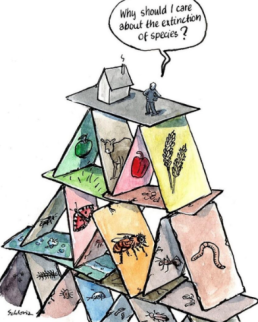
The entire prosperity of mankind is built on the different species and their functions in the ecosystem. Similar to a house of cards, the species perform important functions, mostly serving as a resource and thus contributing to our survival and our current civilization. However, this use of natural resources by humans has long exceeded any limits; the earth and its ecosystems cannot renew themselves to the extent that we exploit them. Around 150 species become extinct every day, and the trend is rising, resulting in a general decline in biodiversity. The destruction of habitats, the overexploitation of resources, the introduction of invasive alien species, air and water pollution and climate change are the most important factors here. The house of cards is threatening to collapse.
Invasive species and their significance for biodiversity
Time and again, so-called alien species are found in ecosystems in which they are not actually native. These species are called neobiota. At first glance, their arrival in an ecosystem sounds like an enrichment of biodiversity. In some cases, this may be true. However, many non-native species tend to have a detrimental effect on their environment and biodiversity, which is why these species are referred to as invasive neobiota. However, the most common cause of the occurrence of invasive species is the intentional or accidental introduction by humans. This means that invasive alien species overcome natural barriers. The foreign ecosystems are often defenceless against them due to the lack of natural enemies. The occurrence of invasive species in ecosystems is also favored in many cases by climate change. Changing temperatures also change ecosystems and thus offer alien species a basis for life that was not there before. Once they have invaded an ecosystem, invasive species can act as strong competitors or predators of native species. They can introduce parasites and pathogens to which they themselves are immune, but against which native species have no resistance. This displaces native species or greatly reduces their population, which can have a negative impact on the entire food chain and the ecosystem. If, for example, an animal or plant is missing from the food chain at any point in the ecosystem, the next species is also endangered; a chain reaction occurs. The World Biodiversity Council (IPBES) describes the “invasion of alien species” as one of five “direct drivers” of global species extinction. The European pond turtle, the only turtle species that still occurs naturally in Central Europe, is on the brink of extinction. Catching and trade as well as the destruction of their habitats are steadily reducing their population. Since the introduction of the raccoon from North America into regions that are not native to it, it has also been eating the pond turtles. It can simply pull its head and limbs out of the shell openings with its claws. In up to 80% of the pond turtles examined, injuries of this kind are found that were never observed before the raccoons appeared (NABU). Considerable economic damage can also be attributed to invasive species. The raccoons from Europe that moved to Australia in the middle of the 19th century multiplied rapidly in a very short time, destroying the native plants there and causing up to 200 million dollars in agricultural damage every year since then.
UfU focus on invasive species
UfU has been running numerous projects on the topic of invasive species for years, mainly in Saxony-Anhalt, but also in Berlin since last year. UfU has become a specialist in this field and is constantly finding new ways to advance research through innovative approaches. UfU is currently developing a strategy to combat invasive species for the state of Berlin, which aims to optimize official structures and processes so that action can be taken quickly and effectively against the spread of invasive species. In the IGAMon-Dog (Invasive Alien Species Monitoring Dogs) project, domestic dogs are included in species protection. Dog owners and their four-legged friends are trained as species detection dog teams. Thanks to their sensitive nose, dogs are ideal for sniffing out animal and plant species. In the project, the dogs learn to indicate when they discover such an invasive plant species on a walk in their surroundings. The KORINA website and app developed by UfU can be used to report the dogs’ findings and all other discoveries of invasive plant species by photo and location information. The data is regularly checked by biologists at UfU. The project and the app are to be expanded to include invasive animals in the future. The aim is to collect comprehensive data on all invasive species throughout Germany by involving citizens (citizen science). In this way, citizens can support and supplement the scientific studies and thus make an important and major contribution to species conservation.
What can private individuals do against invasive species?
There are a number of things that private individuals can do to prevent the introduction or spread of an invasive alien species:
- Find out about invasive species on the usual websites[3]
- Keep your eyes open when you are out and about in nature. Use your cell phone and the KORINA app[4] or the species finder from the Stiftung Naturschutz[5] to report invasive plants and animals.
- If you have a garden or similar, only plant native species. Garden centers should be able to help you with this.
- Do not bring any plants (seeds) or animals home from your vacation
- Clean your sports and vacation equipment (e.g. tent, SUP board, hiking boots) thoroughly before you use it again.
- Only throw garbage and food scraps in the garbage cans provided for this purpose in the city and in the countryside. Food scraps attract animals. Raccoons in particular are spreading faster and faster as a result, even in urban areas.
- Do not feed or pick up wild animals. Find out beforehand what is allowed and what is not.
[1] Federal Agency for Nature Conservation (BfN) [2] IPBES [3] Korina, Senate Department, Foundation for Nature Conservation Invasive Species Berlin brochure, EU regulation on invasive species [4] APP KORINA [5] APP Species Finder