



August 22, 2022
UfU – Press release: UfU Berlin calls for energy saving programs for schools throughout Germany!
The Independent Institute for Environmental Issues – UfU e.V. has been running energy-saving programs for schools to reduce consumption for over 25 years. In light of the current gas emergency, the Berlin-based institute is calling for energy-saving programs to be made mandatory for all schools in Germany.
Schools have extremely high energy requirements and are among the largest energy consumers in the public sector. Many different user groups, few energy managers at the building owners and a relatively old building stock often drive up the energy consumption of schools unnecessarily. This is why the Independent Institute for Environmental Issues (UfU) developed energy saving programs (fifty/fifty) for schools back in the 1990s. On average, 8 percent of heating energy and 2 percent of electricity consumption can be saved in schools. Originally aimed at reducing CO2 emissions, the program takes on a new relevance due to the risk of a gas emergency in winter: “Schools mostly heat with natural gas or district heating. However, district heating is also primarily produced from natural gas. In Berlin, for example, the proportion of natural gas used for district heating is 73.9 percent. This means that there is an urgent need to reduce the energy consumption of schools, especially due to the risk of a gas shortage,” says Florian Kliche, Managing Director of UfU and responsible for the Energy Efficiency & Energy Transition department. Schools consume an average of 80 KWh/m² or 420 MWh of heating energy per year. That is equivalent to the consumption of 85 households! With over 42,000 schools in Germany, the potential for savings across the country is enormous and can make a significant contribution to reducing gas consumption in Germany if the energy-saving programs are made mandatory. UfU is therefore calling for the programs to be made mandatory for schools in Germany. This needs to happen sooner rather than later so that enough schools have taken part in the programs before it gets colder again. The energy-saving programs consist of a mix of practical measures and educational lessons to change behaviour: “One direct measure that we carry out in almost all schools is adjusting the heating system together with the janitors. Most schools will still be far too warm in 2022 – on average 2-3°C. Every degree Celsius saved reduces energy consumption by 6%. In energy-saving lessons, the pupils are given various measuring devices and join us on energy tours of the schools to discover potential savings. This creates an awareness of energy waste at school among the pupils,” explains Oliver Ritter, project manager of the energy-saving projects. In addition to the various measures to reduce heating energy and electricity consumption, the programs also deal with water consumption and other resources in schools.
Savings successes at Potsdam schools in a year-on-year comparison:
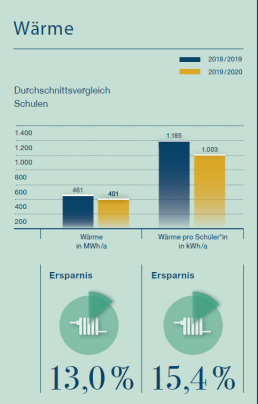
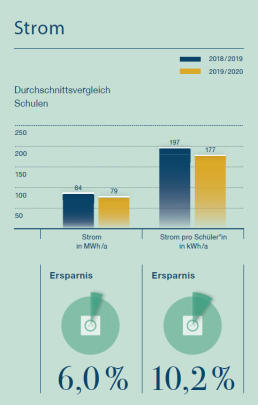
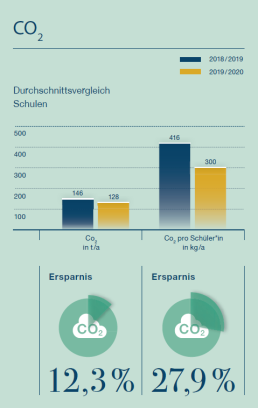
The energy-saving programs (fifty/fity) motivate schools to save energy in everyday school life by changing their user behavior. At the end of each school year, the schools involved in the project receive cash as a thank-you for protecting the climate: half of the energy costs saved are then paid out directly to the participating schools by the school authorities. Today, fifty/fifty is the brand name for all forms of energy-saving projects with a financial incentive system. UfU has already implemented the programs at over 3,000 schools in Germany together with partners. UfU has a broad network of partners in this field to cover the needs of Germany as a whole. The Independent Institute for Environmental Issues is a scientific institute and a citizens’ organization with the aim of analysing and promoting environmental policy developments in a citizen-oriented and time-critical manner, with a focus on the new federal states. Further information on UfU can be found at https://www.ufu.de. The contact person for the project is Florian Kliche(florian.kliche@ufu.de). Please send press inquiries to Jonas Rüffer(jonas.rueffer@ufu.de).