


UfU Information | Issue 8 – March 2023 | Niklas Müller & Jonas Rüffer
War and food security
Why the war in Ukraine is starving people around the world
We have already reported on the impact of the war in Ukraine on global food security in UfU Information Issue #5. However, as the war continues, we have decided to take a closer look at the issue.
Why do wars lead to hunger?
There are many reasons why wars lead to hunger and famine. The most obvious is that domestic production is affected as people working in agriculture, logistics and distribution are conscripted as soldiers and farms are damaged by attacks. In addition, international supply chains and food imports are severely affected when infrastructure elements such as roads or ports are destroyed or cargo planes can no longer fly to the country. Other reasons may include poor planning, inflation or financial bottlenecks for the population.
But how do today’s wars and the associated effects on food security differ from those of the First and Second World Wars? Why is the war in Ukraine causing people around the world to go hungry today?
The First World War: poor planning
In terms of food security, the First World War was characterized by poor planning and miscalculation. Germany sent so many men to the front that there was a shortage of people at home to carry out the physically demanding agricultural work. The remaining workers also lacked horses and other pack animals, which were needed in agriculture at the time. The animals were conscripted to transport military equipment for the army or slaughtered to feed the soldiers[1], which meant that domestic agriculture lacked essential goods to maintain production. Potato production in Germany fell from 52 million tons in 1913 to 29 million tons in 1918[2].
This decline in production was exacerbated by the British naval blockade in the North Sea and led to food becoming scarce in Germany. During the war years, a daily ration for the civilian population consisted of five slices of bread, five grams of butter, 20 grams of sugar and some meat. [ 3] Compared to the pre-war years, the shortage of food increased the rates of tuberculosis, influenza and other immune diseases, infant mortality rose by 50 percent and twice as many mothers died in childbirth. [ 4] In total, over 750,000 people starved to death in Germany during the First World War. [5]
If we look for the reasons for this famine, a lack of planning can be cited above all. The exuberance with which Germany went to war led to a massive miscalculation regarding the goods needed to maintain food production at home. There was a widespread assumption that the war would be won quickly and that soldiers would already be back home to collect the harvest. Germany was in no way prepared for the fact that the declarations of war against Russia, France and Great Britain in August 1914 would develop into a four-year war that would ultimately cost the lives of around 17 million people.
The immune system and the ability to concentrate of people suffering from malnutrition are severely weakened. As a result, they fall ill more often and their performance decreases. This particularly affects children, whose physical development and school performance are impaired. As a result, they are often too thin (wasted) or too small (stunted) for their age and drop out of school more often.
Second World War – Destruction
Triggered by the experiences of the First World War, Germany was better prepared for the Second World War in 1939. The aim was to be independent of food imports and to ensure that the population was supplied with basic foodstuffs from within the country. Studies show that the food supply was already planned in 1937. Stockpiles were well stocked and 100 percent self-sufficiency in grain, potatoes, sugar and meat had been achieved. [6]
Forced rationing was introduced in Germany at the start of the war. Basic foodstuffs such as fat, meat, butter, milk, cheese, sugar, bread, eggs and jam could no longer be purchased as normal from September 1939. Instead, food stamps were introduced to ration the distribution of important staple foods to the population.[7] This meant that the German population was relatively well supplied until the end of the war, mainly due to the heavy exploitation of the conquered territories in the east, at the expense of the population living there.
At the end of the war, however, this situation changed for most people in Germany and the rest of Europe. The countries lay in ruins and had been destroyed to such an extent that food production in Germany fell by 37 percent in 1946 and by 25 percent in 1947 compared to 1938/39. [8] The bombed-out towns and villages made functioning production chains impossible, let alone the establishment of good trade structures with other countries. Germany had to supply an immense number of displaced persons from the now ceded territories, which led to further food shortages. In order to ration the little food available, new food stamps were issued in the various occupation zones with different levels depending on age, employment and party affiliation.
In the years that followed, climatic conditions made it difficult to maintain agricultural production. The summer of 1946 was unusually hot and the harvest was poor. Then in 1946/47 came the coldest winter of the century and a severe famine broke out across Europe. Rivers such as the Elbe and Rhine froze over, inland shipping collapsed and other transport routes were still destroyed by the war. Temperatures dropped to minus 25 degrees and there were 40 days of permafrost.[9] The daily ration of food fell below 1000 calories per day. Depending on age and gender, between 2100 and 3000 calories per day were medically recommended. By 1948, several hundred thousand people had died in Germany and around two million in the Soviet Union. [10]
The destruction of settlements, buildings and other facilities releases toxic chemicals into the environment. These substances have the potential to permanently pollute the soil, water and air and can also find their way into food through irrigation and the soil after the end of the war. Contaminated food can in turn lead to serious illness if consumed.
Globalization and war
In the global economy of the 21st century, wars not only affect the food security of those who suffer direct destruction. Due to higher food prices and supply shortages, the effects of wars today also affect lower-income people in other parts of the world.
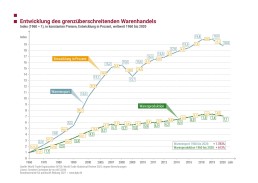
Prior to globalization, most countries mainly produced food and goods for their own needs, as illustrated by Germany’s self-sufficiency during the Second World War. However, over the course of the 20th century, exports of goods increased more rapidly than the production of goods (see figure: Development of cross-border trade in goods). Companies around the world began to specialize in the production of certain foodstuffs and goods because this meant higher profits. Missing products were imported from other countries, as they could be produced more cheaply there. As a result, exports of goods increased with comparatively little increase in the production of goods. However, the pursuit of higher profits led to economic dependencies and strong interdependencies worldwide. In many countries today, the population’s food supply can no longer be guaranteed without imports.
When wars are waged, supply dependencies are particularly dangerous for countries that import a lot of food. Supply bottlenecks caused by war make it more difficult to import food and the resulting price increases make food less affordable for low-income households. This connection will be illustrated using the current example of the war in Ukraine.
War Ukraine & Russia
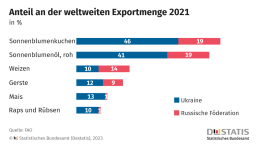
In 2021, Russia and Ukraine were among the world’s largest exporters of wheat, barley, corn and sunflower oil (see figure: Share of global exports in 2021). Russia was the world’s largest wheat exporter with 33 million tons and Ukraine the fifth largest with 20 million tons. In terms of barley exports, Ukraine was in second place worldwide and Russia in third place. The situation is similar for maize and sunflower oil. [11] This is mainly due to the fact that agriculture in both countries benefits from large areas, fertile soils and a suitable climate.
The effects of the war are currently leading to a decline in exports of grain and vegetable oils. Harvests can only be harvested, shipped or processed to a limited extent if people working in agriculture, logistics and distribution are conscripted as soldiers or if farms and machinery are destroyed by the war. As a result, fields cannot be cultivated and full granaries cannot be emptied, which may even cause stocks to deteriorate. There is also a lack of fuel, seeds and fertilizer. Russia and Belarus, which are among the world’s largest exporters of fertilizers, have greatly reduced their exports in 2022. [12]
In addition to destruction, strategic blockades often prevent trade in food and other goods. During the First World War, the British naval blockade in the North Sea prevented essential goods from reaching Germany. Since Russia’s invasion of Ukraine, a similar naval blockade by Russian forces in the Black Sea has prevented cargo ships from leaving Ukrainian ports. Before the war began, over 12 percent of global wheat exports and 16 percent of corn exports were handled via the port of Odessa. With the blockade, the grain was loaded onto trucks and shipped from Romania, which increased the transportation costs for these important staple foods. The blockade has now been lifted, but cargo shipping is still at great risk from sea mines. [13]
The declining supply of grain and vegetable oils on the global markets has been met by rising demand for years, which has contributed to an increase in food prices.[14] The situation is particularly worrying in countries that have a high per capita consumption of grain and vegetable oils and mainly obtain these agricultural products by sea from Russia and Ukraine. One example is Egypt. In Egypt, around 200 kg of wheat is consumed per capita per year, which accounts for around a third of an Egyptian’s calorie intake. This compares with around 80 kg in Germany. As Egypt is the world’s largest importer of wheat, the country’s population is particularly hard hit by supply shortages and price increases. [15]
Initial estimates assume that an additional 8 to 11 million people worldwide will suffer from malnutrition as a result of the war in Ukraine, particularly in Africa, South East Asia and the Middle East.[16] As a result, the world is currently facing the worst famine since the Second World War, affecting more than 50 million people worldwide. Although there are alternative producers of grain and vegetable oils on the world markets, the rise in oil prices is increasing transportation costs from countries such as Australia, Argentina, Canada and the USA. Higher transportation costs in turn result in higher food prices, which means that these producers are often not a more cost-effective alternative.
Wars have always had an impact on the food security of the population. However, in the course of globalization, economic dependencies and the export of goods between countries continue to increase. This is why the war in Ukraine is threatening the food supply of households worldwide. It is crucial, not only for Ukraine, to return to peace.
References:
[1] Wolfgang Görl, Süddeutsche Zeitung, On offer: badgers and squirrels, 11.08.2014
[2] Burkhard Asmuss, German Historical Museum, First World War – The food supply, 14.09.2014
[3] Knut Weinrich, Planet Wissen, The Home Front, 09.05.2018
[4] Arnulf Scriba, German Historical Museum, The “Cabbage Turnip Winter” 1916/17, 08.09.2014
[5] Burkhard Asmuss, German Historical Museum, First World War – The food supply, 14.09.2014
[6] Arnulf Scriba, German Historical Museum, The Second World War – Everyday Life, 13.05.2015
[7] Arnulf Scriba, German Historical Museum, The Second World War – Everyday Life, 13.05.2015
[8] Karl-Heinz Rothenberger, regionalgeschichte.net, Die Hungerjahre nach dem Zweiten Weltkrieg am Beispiel von Rheinland-Pfalz, 1997
[9] Michael Kuhlmann, Deutschlandfunk, Post-war Germany in the daily struggle for survival, 16.11.2021
[10] NDR, The “white death” in the hunger winter of 1946/47, 02.05.2022
[11] Food and Agriculture Organization of the United Nations, The importance of Ukraine and the Russian Federation for global agricultural markets and the risks associated with the current conflict, 2022
[12] Tobias Heidland, Federal Agency for Civic Education, The Ukraine war and global food security, 21.06.2022
[13] Kevin Schulte, ntv, How Russia is blockading the Black Sea, 15.07.2022
[14] Tobias Heidland, Federal Agency for Civic Education, The Ukraine war and global food security, 21.06.2022
[15] Tobias Heidland, Federal Agency for Civic Education, The Ukraine war and global food security, 21.06.2022
[16] FAO, IFAD, UNICEF, WFP and WHO. 2022. The State of Food Security and Nutrition in the World 2022: Repurposing food and agricultural policies to make healthy diets more affordable.