


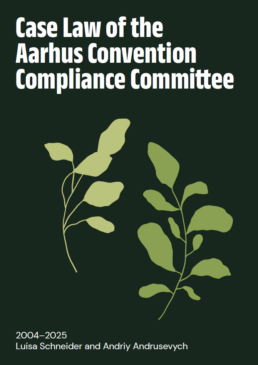
New Publication: Updated Case Law of the Aarhus Convention Compliance Committee
Since its establishment, the Aarhus Convention Compliance Committee (ACCC) has developed a comprehensive body of case law, thereby making a decisive contribution to ensuring that the rights enshrined in the Aarhus Convention are upheld in practice. To make this case law more accessible and easier to use, a new collection of cases (Case Law of the Aarhus Convention Compliance Committee) has now been published, compiled by Andriy Andrusevych and Luisa Schneider.
The publication brings together and systematises the Compliance Committee’s case law on the three pillars of the Aarhus Convention: access to environmental information, public participation in decision-making on environmental matters, and access to justice. The aim of the case collection is to present the ACCC’s extensive case law as a practical working tool, thereby facilitating its application.
The case collection is aimed at civil society organisations, courts, lawyers, academics, policy-makers and public authorities. It is intended to assist in assessing national legislation and administrative practices for their compatibility with the Aarhus Convention and to strengthen the Convention’s implementation in practice. Given the growing challenges to environmental and participation rights in many European countries, the Compliance Committee’s case law is of particular importance. The Committee’s decisions provide key guidance on the interpretation of the Convention and help to strengthen environmental rights as an essential component of the rule of law and democratic participation.
In light of the biodiversity crisis and climate change, these environmental rights are far more than abstract legal principles. They enable citizens and civil society organisations to campaign effectively for the protection of the environment and to ensure that government action is scrutinised transparently and in accordance with the rule of law. The new collection of case studies aims to help make this knowledge more widely accessible and to promote the practical application of the Aarhus Convention.
The publication was produced as part of the BELIFE project and is available via the following link.