


UfU Information | Issue 9 – July 2023 | Niklas Müller, Larissa Donges
Environmental (in)justice in Berlin
Environmental pollution hits Neukölln harder than Steglitz-Zehlendorf
It’s getting hotter and hotter in the capital. In 2020, Berlin was the warmest federal state with an average annual temperature of 11.4 °C. Compared to the years from 1971 to 2000, the average daily maximum temperature will rise by up to 1.9 °C by 2060.[1] This rise in temperature increases the likelihood of hot summers and heavy rainfall events. However, the individual districts and residents in Berlin are affected to varying degrees. The city therefore still has a long way to go in terms of climate adaptation and environmental justice.
The concept of environmental justice aims to avoid or reduce health-relevant environmental pollution such as noise, heat or air pollutants in socially disadvantaged neighborhoods and residential areas and to provide their residents with access to environmental resources such as green, water and open spaces to relieve the burden. [ 2] The reasons given include the fact that continuous noise pollution causes heart disease or sleep disorders and increased particulate matter pollution can lead to premature death. Reducing health-relevant environmental pollution therefore not only promotes individual health, but also reduces health insurance costs and consequently the general costs to society. However, environmental pollution and resources are unevenly distributed in most cities. Some districts, for example, are exposed to multiple levels of air pollution, noise and heat due to congested roads and high-density building stock. Other districts, on the other hand, are characterized by quiet and green residential areas where noise and air pollutants have little or no impact on people’s health and green spaces are within walking distance for everyone.
[3]
To map the differences between the various districts, the Berlin Senate Department for Mobility, Transport, Climate Protection and the Environment (SenMVKU) was the first German city to publish the Environmental Justice Baseline Report in 2019. This was updated in 2022 and published as the Berlin Environmental Justice Atlas.
It uses the five core indicators of air pollutants, noise pollution, bioclimatic pollution (heat), social problems and green space provision to measure environmental justice in Berlin. Steglitz-Zehlendorf performs one of the best here. The district has relatively low to no environmental pollution for almost all core indicators, as can be seen in Figure 1 from the yellow and green areas. In addition, the supply of green-blue infrastructure is very good.[4] The term includes parks, green roofs, green facades, lakes and rivers, for example. Vegetation and bodies of water make up 35.5 percent of the area and many residents have their own garden. A quarter of the area alone is forested. This makes the district one of the greenest in Berlin[5] and suggests that environmental pollution decreases as the density of green spaces increases. The north of Neukölln, on the other hand, is highly densely populated and in some areas shows environmental pollution in three to five different core indicators. This can be seen in the dark orange and dark red areas in Figure 1.[6] Furthermore, there is a lack of sufficient green-blue infrastructure. Although 21 percent of the area of the district is sports, leisure and recreation areas, only 3 percent is water and vegetation. [7]
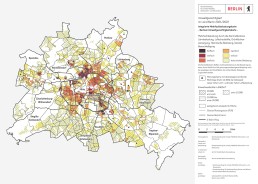
But the lack of access to environmental resources is not the only obstacle in Neukölln on the way to greater environmental justice. Alongside Mitte, the district has the highest level of social disadvantage. 8] At the same time, the densely built-up north, where a large part of the population lives, is heavily affected by two or more core indicators of the Environmental Justice Atlas. This illustrates that people who live close to the city center and are socially disadvantaged are disproportionately exposed to multiple stressors such as noise, air pollution and heat. As a result, they are particularly disadvantaged in terms of environmental quality, health and social situation,[9] which means that the age at death in socially disadvantaged neighborhoods is up to six years below the urban average. [10] Neukölln ranks last in the health and social index of the Senate Department for Science, Health and Care (SenWGP) in 2022. For example, the district has one of the highest unemployment rates and one of the lowest average life expectancies. Steglitz-Zehlendorf, on the other hand, is the district with the lowest social and health burdens and has the lowest proportion of apartments in basic residential areas. [11] This describes areas in the inner city that are predominantly densely populated and have very few green and open spaces.[12]
However, the Berlin Environmental Justice Atlas is only an inventory that must be followed by concrete measures to ensure environmental justice. One of these is the expansion of urban green and open spaces, which as recreational areas contribute to a healthy life for the population by reducing environmental pollution such as heat, air pollution and noise. [13] For example, green façades and green roofs serve to insulate buildings and reduce the costs of air conditioning in summer and heating in winter. In turn, street trees and parks cool the city in summer by providing shade and cooling the environment through transpiration. [14] extract heat. In a detached house with a garden in Steglitz-Zehlendorf, it is therefore easier to endure a hot summer’s day than in an attic apartment in the north of Neukölln. Furthermore, green spaces reduce the risk of flooding as they are better able to store rainwater through infiltration than sealed surfaces such as streets or parking lots. This means that a basement in Steglitz-Zehlendorf is less likely to flood during heavy rainfall than one in the north of Neukölln. Due to the climate crisis, the probability of heatwaves and heavy rainfall events will continue to increase in the coming years. This is why the expansion of green infrastructure in densely populated neighborhoods such as in the north of Neukölln is crucial for Berlin’s climate adaptation.
For this reason, residential areas that are undersupplied with greenery and socially disadvantaged areas must be defined as focal points for action in urban planning and urban land-use planning in future. In addition, urban land-use planning should aim to safeguard air quality and ensure that, for example, industrial plants are avoided in residential areas. Urban planning should therefore ensure healthy living and working conditions by considering indicators such as building density, sunlight and ventilation. [15] For example, contiguous, obstacle-free areas from the surrounding countryside to the urban area, so-called fresh air corridors such as the Spree and Tempelhofer Feld, promote air exchange and the cooling of the city in summer. Accordingly, existing fresh air corridors should definitely be retained and new ones created. Of course, emerging conflicts of interest such as the expansion of affordable housing due to the acute housing shortage must not be ignored.
Noise action plans such as the Berlin Noise Action Plan 2019-2023, which develop concrete measures based on noise mapping and public participation, serve to reduce noise pollution and protect quiet areas. These include reducing the speed limit, installing noise-optimized road surfaces and longer-term approaches to mobility transition. The latter is also an effective climate protection measure to reduceCO2 emissions. For example, it is much easier to switch from cars to bicycles or public transport if the expansion of cycle paths and local public transport takes precedence over the construction of a new highway. Finally, the city is making a number of other efforts to promote environmental justice in Berlin. For example, the Clean Air Plan for Berlin, the Charter for Berlin’s Urban Greenery and the Action Alliance for Heat Protection set out measures to reduce air pollution, promote green infrastructure and prepare health stakeholders for heatwaves.
With the Environmental Justice Atlas, Berlin has taken the first step towards a more environmentally friendly future. But the goal is still a long way off. This is why UfU is currently working on a practical guide to implementing environmental justice in Berlin’s neighborhoods with the aim of addressing the specific needs and experiences of neighborhood managers in disadvantaged districts and supporting them in promoting environmental justice. At the beginning of May, the congress “Environmental Justice in Neighborhoods – Networked and Participatory Shaping the Future” also invited representatives from politics, administration, civil society, research and practice to exchange ideas on the topic of environmental justice in Berlin and to explore interfaces for future cooperation. The hybrid congress was organized by UfU and BUND Berlin and funded by the SenMVKU, as was the practical guide. Finally, it can be said that environmental justice contains the word “right”. But rights are only as strong as their implementation. For this reason, the lively discussion about environmental justice in Berlin must now be followed by concrete action.
References
[1] Impacts of climate change, In: Senate Department for Mobility, Transport, Climate Protection and the Environment, 2023 [2] Bolte, Gabriel et al (2012): Environmental justice through equal opportunities in environment and health. An introduction to the topic and objectives of this book, In: Umweltgerechtigkeit. Equal opportunities in environment and health: concepts, data situation and perspectives for action, pp. 15-37 [3] Böhme, Christa et al. (2023): Gemeinsam planen für eine gesunde Stadt – Empfehlungen für die Praxis, In: Umweltbundesamt Broschüren [4] Senate Department for the Environment, Mobility, Consumer and Climate Protection (2022): Die Umweltgerechte Stadt – Umweltgerechtigkeitsatlas Aktualisierung 2021/22 [5] Flächennutzung in Steglitz Zehlendorf, Amt für Statistik Berlin Brandenburg, Bezirksamt Steglitz-Zehlendorf, September 2021 [6] Senate Department for the Environment, Mobility, Consumer and Climate Protection (2022): Die Umweltgerechte Stadt – Umweltgerechtigkeitsatlas Aktualisierung 2021/22 [7] Gebietsflächen in Neukölln, Statistisches Jahrbuch 2020 / Amt für Statistik Berlin Brandenburg, Bezirksamt Neukölln, 31.12.2019 [8] Bericht Monitoring Soziale Stadtentwicklung Berlin 2021, In: Senatsverwaltung für Stadtentwicklung Bauen und Wohnen [9] Senate Department for the Environment, Mobility, Consumer and Climate Protection (2022): The Environmentally Sound City – Environmental Justice Atlas Update 2021/22
[10] Böhme, Christa et al. (2023): Planning together for a healthy city – recommendations for practice, In: Umweltbundesamt Broschüren
[11] Department for Health Reporting, Epidemiology, Health Information System, Statistical Office, Senate Department for Science, Health, Care and Equality Berlin (2022): Health and Social Structure Atlas Berlin 2022
[12] Berlin rent index 2023, residential area, In: Senate Department for Urban Development, Building and Housing
[13] Böhme, Christa et al. (2023): Planning together for a healthy city – recommendations for practice, In: Umweltbundesamt Broschüren
[14] Plant research, Transpiration, In: Pflanzenforschung.de, Federal Ministry of Education and Research
[15] Böhme, Christa et al. (2023): Planning together for a healthy city – recommendations for practice, In: Umweltbundesamt Broschüren