


July 10, 2020
Cities are both drivers of global warming and increasingly affected by its impacts. For this reason, the importance of urban green-blue infrastructures (GBI) in the strategic planning of urban spaces is growing, as they are important elements of nature-based solutions (NBS) for climate change adaptation. GBI are also strongly linked to the quality of stay, environmental justice, health and human well-being in cities. The GreenCityLabHuế project aims to strengthen the climate resilience of the city of Hue (Thua Thien Hue Province, central Vietnam) through NBS with a focus on heat adaptation and air quality improvement. A multidisciplinary research and experimentation space will be created to develop, test, visualize, discuss and implement ideas and concepts to restore and enhance GBI and thus promote and implement NBS in the urban area of Hue. During its definition phase, the GreenCityLabHuế project created a typology of GBI elements and, on this basis, initial narratives and scenarios for GBI development in Hue. Initial studies on the current situation and the prerequisites for future GBI developments in Hue are listed in the Status Quo Report. The report contains information on Hue’s urban development, current societal challenges due to climate change, a status quo analysis of GBI in Hue city, the policy framework for NBS development and social aspects for NBS development in Hue. Hue is one of the oldest urban areas in Vietnam. The core city covers an area of approximately 71 km² and is one of the most densely populated Vietnamese cities. With approx. 12.9 m² / person, the green space per capita in Hue is comparatively high. However, green spaces (and blue spaces) are not evenly distributed across the city – with access to green spaces in the historic center of the city being particularly limited – highlighting the need to implement new GBI elements. Initial assessments of climate change impacts indicate that generally warmer conditions and an increase in annual rainfall totals are to be expected. For the city of Hue, a low to moderate increase in near-surface air temperature (both in terms of annual average and extreme temperatures) and a moderate to comparatively high increase in annual precipitation are predicted. Events that are already significant today – heat stress and flooding – will therefore most likely be exacerbated by climate change. Air pollution and noise pollution pose further environmental challenges, especially in the dense center of the core city and the university campus. Based on co-creation and co-learning, the GreenCityLabHuế project proposes a typology of 64 GBI elements to be considered, including, among others, different types of private, commercial or institutional green spaces, allotment gardens, community green spaces, recreational parks and gardens, and agricultural GBI. The elements covered include GBI elements common to both (Central) Vietnam and Germany (or Europe), as well as infrastructures unique to Hue.
The latter include, for example, green-blue gardens, cafés with garden flair and the garden houses that are traditional for Hue. In the further project, the developed typology in combination with an analysis of relevant planning and development guidelines as well as the review of previous, current and future projects for the implementation of NBS serves as a basis for the implementation of land use change scenarios and for the evaluation of the benefit effects resulting from the improvement of GBI in the city of Hue. In addition to the introduction of new green (and blue) areas, the need to protect, preserve and enhance existing elements of the GBI was also recognized. This includes, for example, maintaining street tree density through annual tree planting campaigns, as mature trees in particular are under pressure due to climate change. The expansion of the GBI in Hue addresses the aforementioned environmental problems by optimizing the provision of ecosystem services and increasing urban resilience to extreme weather events and climate change. In addition, the economic and social benefits of the GBI as NBS are also targeted, which include positioning the city of Hue as an (eco-)tourism destination, creating employment opportunities, establishing a competitive advantage over other Vietnamese cities, improving the quality of life by creating public spaces and promoting public awareness of green-blue infrastructures. Further information on the project can be found at www.greencitylabhue.com
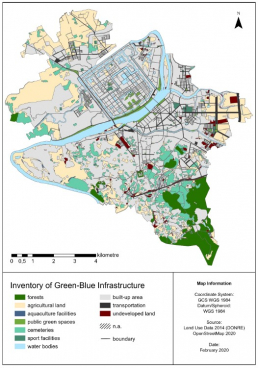
Inventory of green-blue infrastructure in the city of Hue, derived from land use data from 2014 from DONRE and OpenStreetMap
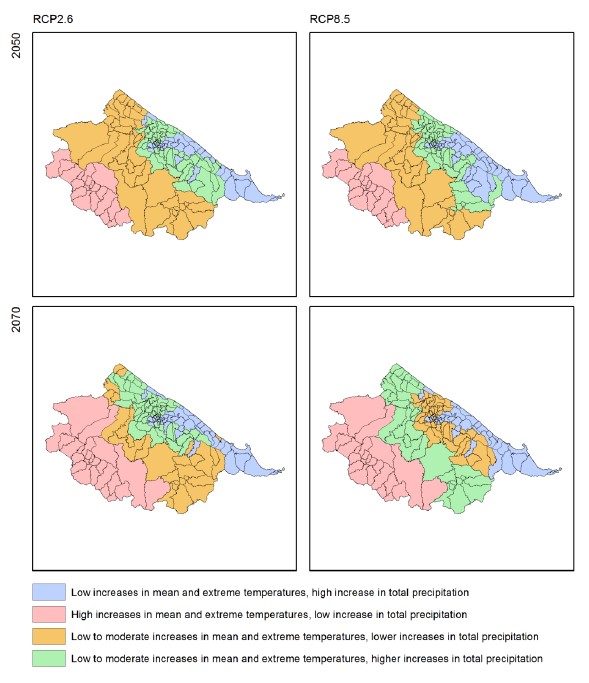
Combined trends in climate indicators for the years 2050 and 2070 and for the RCP scenarios RCP2.6 and RCP8.5
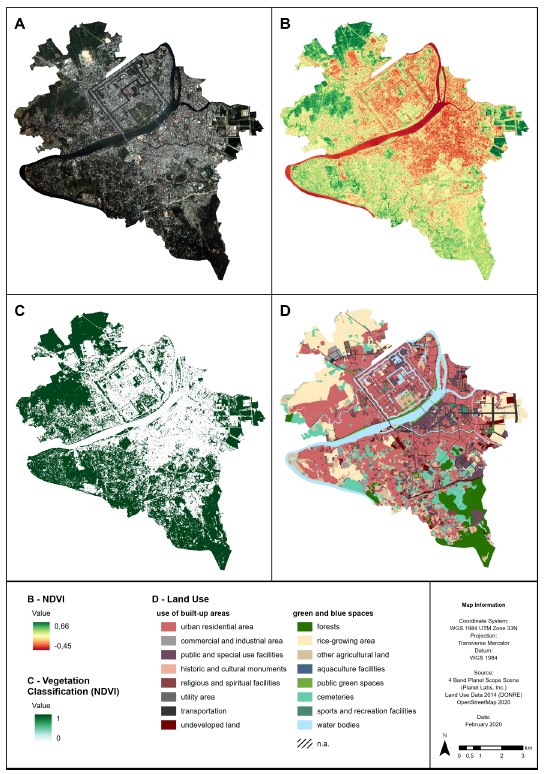
PlanetScope satellite image of Hue city on February 20, 2020 (A), the normalized difference vegetation index (NDVI) of the Earth observation indicator calculated on the PlanetScope image (B), the vegetation classification based on the NDVI (C) and the land use map (D)