


UfU Information | Issue 8 – March 2023 | Jonas Rüffer
The last generation
A classification of the current debate with John Rawls
Are they allowed to do that?
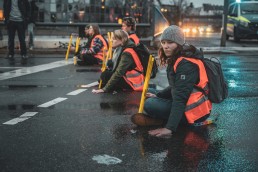
They can no longer be overlooked. Climate activists from the group “The Last Generation” and other groups such as “Just stop oil” are drawing attention to themselves and the impending climate crisis through controversial demonstration formats such as street blockades and museum actions and have been part of a broad media discussion for weeks.
The main focus of the media discussion is not on the question of how to combat the cause of these demonstrations, but how to deal with these groups themselves. Only a few manage to report and discuss the issue objectively. However, as it can be assumed that such forms of protest will become more frequent in the future in relation to climate change – the climate crisis is currently intensifying and with it the political concerns of these groups – a well-founded discussion of the topic is necessary.
Civil disobedience – Rawls’ theory of justice
First of all, it is appropriate to explain the theoretical foundations of civil disobedience, as these are rarely discussed in the wider media. Civil disobedience is not a new concept. Ghandi, Martin Luther King Jr., the anti-nuclear movement – they all invoked civil disobedience. The beginnings of a definition of civil disobedience go back to Henry David Thoureau. Thoureau is considered not only the creator of the term but also a practitioner of civil disobedience. In 1846, Thoureau refused to pay his poll tax and, in his words, resigned his communion with the United States because he disagreed with slavery and the war of expansion against Mexico. [ 1] Thoureau spent a night in prison for this. With his essay “The Resistance to Civil Government”, published in 1849, he laid the foundation for the idea of civil disobedience, which was later invoked by many movements. Since then, the concept has been an integral part of theories of justice and discussions about obedience and political decision-making.
In the following text, the theory of John Rawls will be used to define and explain civil disobedience. John Rawls is one of the best-known political philosophers of the 20th century, taught at Harvard and described civil disobedience in his world-famous magnum opus “A Theory of Justice” from 1971.
John Rawls defines civil disobedience as a “(…) public, non-violent, conscience-driven, but politically unlawful act, usually intended to bring about a change in the law or government policy.”[2]
Rawls presupposes an almost just society for his theory, i.e. a society with functioning democratic institutions, separation of powers and participation of the civilian population. For Rawls, there is no such thing as a completely just society, because even in a just society, injustices occur from time to time.
According to Rawls, this almost just society has a valid sense of justice that is accepted and supported by the broad majority of society. This sense of justice can be interpreted as a kind of awareness, shared values or society’s sense of “right” and “wrong”. If this feeling is disturbed by injustice, society acts to restore justice. Rawls builds his theory of civil disobedience on the basis of this consciousness in society.
When the principles of justice are violated
Not every injustice within society justifies civil disobedience. According to Rawls, unjust laws must also be accepted in an almost just society if they do not exceed a certain level of injustice.[3] However, society attempts to uphold the principles of justice at all times. If the sense of justice is disturbed by unjust laws, action must be taken to restore the almost just society.
Rawls links the choice of legitimate means to certain conditions. In order to be able to exercise civil disobedience, two conditions must be met:
According to Rawls, the first prerequisite for civil disobedience is “(…) serious violations of the first principle of justice, the principle of equal liberty, and (…) flagrant violations of the second part of the second principle, the principle of fair equality of opportunity.”[4]
The connection that can be drawn between the last generation and the second principle of equal opportunity is already clear here. If equality of opportunity and the principle of equal freedom are violated, Rawls considers these to be such serious violations of society’s sense of justice that they cannot be tolerated.
The second prerequisite for civil disobedience for Rawls is the fact that other means such as ordinary appeals, legal protests and demonstrations for the purpose of redressing injustice are sincere but must be regarded as having failed.[5]
Here, too, a reference to the last generation can be made when you consider how long scientists have been warning of the consequences of climate change, how large the Fridays for Future demonstrations are and how badly we continue to fall short of the Paris climate targets.
Since, for Rawls, civil disobedience always appeals to society’s prevailing sense of justice and aims to draw attention to injustices within society, it is self-evident for Rawls that civil disobedience must take place in public and without violence. After all, those who engage in civil disobedience want to convince people of the sincerity of their own cause: “Complete openness and non-violence is a pledge of sincerity, for it is not easy to convince someone else of the conscientiousness of their actions (…).”[6]
Rawls thus also distinguishes civil disobedience from militant action, thinking here of terrorist groups such as the RAF: “(…) Civil disobedience in this sense is clearly different from militant action and obstruction, and it is something completely different from organized violent resistance.”[7]
Due to the fundamental appeal to the sense of justice within society, the acceptance of democratic and state institutions is a central feature of civil disobedience. In contrast, militant resistance no longer recognizes the existing institutions as just and has lost trust in society. The basic principle of militant resistance is the conviction that society has lost the general concept of justice or that it is wrong. For this reason, militant resistance no longer has the option of appealing to a sense of justice through civil disobedience. Militant resistance thus attacks society and the system as a whole. At the same time, militants are not prepared to accept the legal consequences of their actions, as they consider the laws of society to be unjust and therefore cannot accept them. [ 8] Those who engage in civil disobedience, however, recognize the prevailing conception of justice, the democratic institutions and the consequences of their own violation of the law: “(…) in order to justify civil disobedience, one invokes (…) the common concept of justice that underlies the political order. The law is broken, but law-abidingness is expressed in the public and non-violent character of the act, in the willingness to accept the legal consequences of the action.”[9]
The decisive difference between organized violent resistance and civil disobedience therefore lies in the deliberate violation of the law within the commonly agreed rules, without questioning these rules per se. Not only are society and its sense of justice itself not called into question, but an attempt is made to protect precisely this sense of justice and the democratic institutions through civil disobedience.
Hate, mockery & agitation – the outcry of the political establishment
Applying Ralw’s theory to the actions of the last generation, it is alarming to see the extent to which this group is condemned by politicians for their actions. Comparisons with terrorism, demands for prison sentences and labels such as “climate criminals” not only testify to a lack of knowledge about civil disobedience, but also show that the last generation is hitting a sensitive nerve with the political establishment, which is apparently no longer able to withstand dissent from the population.
So far, the group has clearly been classified as civil disobedience and by no means as militant resistance. The last generation has taken up the cause of non-violence. 10] Anyone who remembers the RAF or has ever studied the suffragettes will quickly come to the realization that there is a big difference in the radicality of the means chosen between a road blockade, sending letter bombs and the murder of the president of the employers’ association – even critics of the last generation will have to realize this.
Accordingly, statements such as the supposed warning of a climate RAF as made by Alexander Dobrindt in the Bild newspaper on November 6, 2022[11] are clearly out of place. Accusations such as those made by Sebastian Czaja, Chairman of the FDP Berlin, formerly in the CDU – he described the activists on Twitter on 2 November as climate criminals who hate the balancing of interests, hold the working middle class hostage and despise democratic institutions[12] – also ignore the fact that the last generation has not yet asked the systemic question, is not calling for a revolution and is addressing its demands to the democratically legitimized government. As explained in Rawls’ definition, it therefore acts within society’s sense of justice and does not question it. This view is even confirmed by the President of the Office for the Protection of the Constitution, Thomas Haldenwang: “Groups are always extremist “when the state, society, the free democratic basic order [is questioned]. (…) And that’s exactly what people don’t actually do.”[13]
The fear of democracy
In addition to inappropriate comparisons with terrorist organizations, there is a broad political consensus regarding the demand for harsher penalties for activists. On Thursday, November 10, 2022, even the Bundestag discussed tougher penalties for climate activists. [ 14] Even Federal Minister of Justice Dr. Marco Buschmann does not rule out the possibility of prison sentences in the Bild newspaper and calls for the legal framework to be used for this. [ 15] The Hessian Minister of Justice Roman Poseck (CDU) takes it to the extreme, considering it possible under certain circumstances to punish the activists like terrorists. [ 16] Professor of law and former chairman of the second senate of the Federal Court of Justice Prof. Dr. Thomas Fischer can be quoted on such reports: “(…) it is always depressing to see that not insignificant sections of the press attribute to the ministers of justice a direct power to intervene in the criminal courts and intervene in the public prosecutor’s offices, i.e. insinuate an outright unconstitutional state practice.” [17]
In the discussion about the right level of punishment for the actions of the last generation, there is no getting around one observation: Anyone who throws around demands for harsher punishments for the activists not only has to put up with the question of how harsher punishments should contribute to solving the existing conflict – climate change and the government’s failure to act, which the activists denounce, have not been eliminated by simply locking the activists up – but also the critical question of what this says about their own basic understanding of politically active citizens.
The last generation consists of people who use their blockades as a form of political protest because they want to draw attention to a grievance in society. These people’s sense of justice is massively distorted (see the section on climate anxiety in the foreword to this issue) and they deliberately choose civil resistance to draw society’s attention to this imbalance. Those who immediately call for harsh punishments show a questionable understanding of political citizenship.
A democracy is characterized above all by the political participation of all people who meet certain conditions (citizenship, age, etc.). The nature of these conditions and participation differs in the various democratic systems. The greatest common feature of these systems is certainly the establishment of regular elections. These elections not only express the political will of the citizens, but also make the political citizen the sovereign vis-à-vis the government and give it legitimacy.
However, this sovereignty is by no means limited to election day, which takes place at regular intervals, but is expressed through various rights of political participation, such as the right to demonstrate, at any time. The legitimacy granted to the government and thus also the legitimacy for laws and other political action must be revocable at any time, otherwise the sovereignty of the citizen exists only in appearance. Étienne Balibar, French philosopher, describes this important condition for political citizenship in his 2009 text Resistance Revolt Obedience: “This is the paradox of political citizenship: in order to be able to say yes in a way that expresses real power, one must occasionally and possibly regularly say no.”[18]
So anyone who engages in political protest – in what way is irrelevant to this statement – is first and foremost exercising active political citizenship. If this active exercise of political citizenship takes place within our democratic legal principles – civil disobedience is part of this – it is to be regarded as part of democratic political participation. Balibar goes even further in his argument: for Balibar, this active exercise of citizenship in a democracy is not only a civic duty, but ultimately also legitimizes and strengthens the political system: “If some, who at first are never the totality of citizens and may even be only a tiny minority at the beginning, although they objectively act in the general interest, do not take it upon themselves to oppose and exercise the function of dissident, then there are only passive citizens and finally no more citizens at all, but only more or less participating, more or less easily” governable “administrative citizens or subjects of power.”[19]
Balibar thus argues here that those who exercise their dissent in the democratic system keep democracy itself alive and prevent it from declining into a mere system of administering citizens who are unable to exercise their rights.
This view was also held by John Rawls: “Together with regular free elections and independent courts to interpret the (not necessarily written) Constitution, frugal and balanced civil disobedience contributes to the preservation and strengthening of just institutions.”[20]
The members of the last generation are therefore politically active citizens and should be treated as such. When it comes to the question of how to deal with the group, it is therefore irrelevant whether the chosen means of protest does a disservice to climate protection or not. As long as the last generation is committed to publicity and non-violence, its members are acting within the principles laid down by Rawls. In this respect, criminalization, as demanded by many, is also pointless: “In order to save itself as a community of citizens or to stay alive, the polis must expose itself to the risk of destruction or anarchy in confrontation with its own members, from which nothing can save it, especially not the criminalization of dissidence or the attempt to smell treason in every refusal to obey orders for reasons of conscience.”[21]
In fact, the question must be asked at this point as to what goal is being pursued here with harsher punishments. What does it say about a society that prefers to see people who have been disruptive but non-violent in their efforts for a better future behind bars rather than investigating the injustice being denounced and changing their behavior?
What if they become radicalized?
The criminalization of the last generation, in this respect Balibar is right, does not prevent our society from dealing with the last generation and its demands and thus also from putting the current sense of justice within our society to the test. What’s more. We should ask ourselves what impact an increasing criminalization of the group could have on society itself and such groups. What signal are we sending with the increasing criminalization of the last generation to people who suffer from climate anxiety and have scientifically justified fears that they will no longer find an acceptable basis for living in the future?
Proponents of the argument that the last generation is not far removed from a terrorist organization often argue that the student movement from which the RAF emerged was also initially non-violent. In fact, the idea that the last generation could become radicalized if the problem denounced by the activists is not solved is not so far-fetched. Anyone can imagine that if the government continues to fail to act, the desperate people clinging to the streets will at some point consider more radical means and then turn to militant resistance. However, the reverse conclusion that harsh punishments would prevent this is wrong.
It has already been discussed that Rawls distinguishes civil disobedience from militant resistance primarily in that the former accepts the current legal system and democratic institutions, while the latter has lost confidence in society’s correct conception of justice. The activists of the last generation therefore still have a certain amount of trust in the government’s and politicians “ability to act, as their forms of protest appeal directly to the federal government. Harsher punishments such as prison sentences and entries in the criminal record not only jeopardize these people’s life plans, but would also exclude people who have acted peacefully up to now from the community. The signal this sends out could be fatal. To use Rawls” words: “Civil disobedience “(…) seeks to avoid violence (…) because it would be a definitive expression of a position. (…). If the appeal fails, one may sometimes consider resorting to violent resistance.”[22] What Rawls is postulating here is the transition of a group from civil disobedience to militant resistance when they feel the appeals are failing. It is precisely this failure that threatens if our only response to the last generation is imprisonment. This criminalizes political citizens and negates the political significance of civil disobedience. Prof. Dr. Katrin Höffler, professor of law at the University of Leipzig, gave an interview on this issue in the taz newspaper on November 25 with the following content: “If there is no communication offer, this will lead to further exclusion of climate activists and increased rebellion. The last generation is not yet rejecting the state, but rather calling on it to act. But if the state gives activists the feeling that it neither listens to them nor understands them, the activists will distance themselves. (…) Harsher penalties lead to an increase in exclusion. The activists are experiencing a so-called anomic situation, meaning that their goal of stopping climate change cannot be achieved with the means at their disposal. Despite all the demonstrations and petitions, the state has so far remained inactive. If the activists now resort to other means, for example by sticking themselves to a street, this is also out of desperation.”[23]
It is clearly the government’s task to strengthen the trust of the last generation in our institutions and democracy and not to drive these people into extremism through ill-considered defamation and criminalization, but to remedy the cause of civil disobedience. Because, “if justified civil disobedience appears to endanger civil peace, then the responsibility does not lie with the protesters, but with those whose abuse of power justifies such resistance.”[24]
At the same time, it is the task of society to bring these people into the center of society, to make offers of conversation and to respond to these people’s disturbed sense of justice. Anyone who justifiably worries about their own future and that of our society and sees civil disobedience as the last chance to make a difference – an overwhelming majority of scientists confirm this – should not be pilloried in public.
References:
[1] Civil disobedience, texts from Thoreau to Occupy 2017, p.40
[2] John Rawls 1971, A Theory of Justice, Civil Disobedience, Texts from Thoreau to Occupy 2017, p.109
[3] John Rawls 1971, A Theory of Justice, Civil Disobedience, Texts from Thoreau to Occupy 2017, p.107
[4] John Rawls 1971, A Theory of Justice, Civil Disobedience, Texts from Thoreau to Occupy 2017, p.118
[5] John Rawls 1971, A Theory of Justice, Civil Disobedience, Texts from Thoreau to Occupy 2017, p.120
[6] John Rawls 1971, A Theory of Justice, Civil Disobedience, Texts from Thoreau to Occupy 2017, p.113
[7] John Rawls 1971, A Theory of Justice, Civil Disobedience, Texts from Thoreau to Occupy 2017, p.113
[8] John Rawls 1971, A Theory of Justice, Civil Disobedience, Texts from Thoreau to Occupy 2017, p.114
[9] John Rawls 1971, A Theory of Justice, Civil Disobedience, Texts from Thoreau to Occupy 2017, p.111
[10] https://letztegeneration.de/mitmachen/werte-protestkonsens/ (Retrieved March 13, 2023)
[11] Ricarda Lang: Last generation is not a “climate RAF”, ZEIT Online, 09.11.2022
[12] Sebastian Czaja, Twitter, 02.11.2022, https://twitter.com/SebCzaja/status/1587786597126139904
[13] Spiegel Online, President of the Office for the Protection of the Constitution does not classify “Last Generation” as extremist, 17.11.2022
[14] Constanze von Bullion, Süddeutsche Zeitung, Bundestag condemns protest of the “last generation”, 10.11.2022
[15] Zeit Online, Federal Minister of Justice considers prison sentences for climate activists possible, 02.11.2022
[16] Hessenschau, Minister of Justice considers terror charges against climate activists possible, 07.11.2022
[17] Thomas Fischer, LTO, Do “climate stickers have to go to jail”?, 04.11.2022
[18] Étienné Balibar, Wiederstand Aufstand Ungehorsam 2009, Civil Disobedience, Texts from Thoreau to Occupy 2017, p.294
[19] Étienné Balibar, Wiederstand Aufstand Ungehorsam 2009, Civil Disobedience, Texts from Thoreau to Occupy 2017, p.294
[20] John Rawls 1971, A Theory of Justice, Civil Disobedience, Texts from Thoreau to Occupy 2017, p.123
[21] Étienné Balibar, Wiederstand Aufstand Ungehorsam 2009, Civil Disobedience, Texts from Thoreau to Occupy 2017, p.295
[22] John Rawls 1971, A Theory of Justice, Civil Disobedience, Texts from Thoreau to Occupy 2017, p.112
[23] Timm Kühn, TAZ, Criminal law is not a solution, Interview with Katrin Höffler, 25.11.2022
[24] John Rawls 1971, A Theory of Justice, Civil Disobedience, Texts from Thoreau to Occupy 2017, p.128