


UfU Information | Issue 6 – October 2022 | Jonas Rüffer
War in Ukraine
The Donbas on the brink of an ecological catastrophe
The destruction of forests, bodies of water and agricultural land are just some of the potential risks of Russia’s war of aggression against Ukraine. According to initial reports, around 487 crimes committed by Russia against the Ukrainian environment have already been recorded (as of September 7, 2022). The following report is an attempt to categorize the initial environmental damage caused by the war in Ukraine.
It should be borne in mind that the information in this report is largely based on research by smaller NGOs and a small number of studies. Even the major studies cited by the OSCE and the Centre for Human Dialogue emphasize the difficult data situation regarding the events in Ukraine.
Although there have been scientific surveys on the environmental impact of the armed conflict since 2014, these mostly end with Russia’s invasion of Ukrainian territory in February 2022. Independent scientific surveys are currently no longer possible, especially in the separatist areas and territory now controlled by Russia, let alone free reporting. The data and information in this article must therefore inevitably always be viewed against the backdrop of the war and may deviate from reality under the circumstances mentioned.
Map of environmental crimes counted in Ukraine
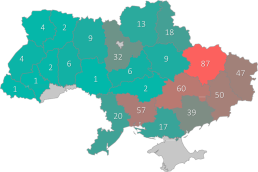
Greatest risks of the Russian war of aggression on the environment in Ukraine
- Radiation exposure due to bombardment of nuclear power plants
- Destruction of agricultural land and forests
- Contamination, pollution and destruction of soil, water and drinking water by hazardous substances
- Destruction of nature conservation areas
Our information providers also include friendly environmental associations in Ukraine with whom we have cooperated in the past or are still doing so. One of these environmental organizations is the Black Sea Women’s Club. Together with this organization, UfU worked on a water management project in the northwest of Ukraine, in the Ternopil region and in the Odessa region on the edge of the Black Sea. The Black Sea Women’s Club was one of our project partners. In July, Liliya Grychulevych, a representative of the NGO, visited us in our office in Berlin to report on the impact of the Russian war of aggression on the Ukrainian environment. We would like to take this opportunity to thank Ms. Grychulevych and the Black Sea Women’s Club for the joint work in our projects and the information that we were able to include in this article.
Another NGO we have been working with since 2018 is the organization Ecoaction. Together with Ecoaction, we are carrying out a project to strengthen civil society in the implementation of national climate policy in Ukraine. We would also like to take this opportunity to thank Ecoaction for the joint projects and the information from Ukraine. Both organizations are calling for measures to restore and preserve ecosystems to be integrated into future reconstruction plans and for the restoration of nature reserves and nature conservation projects in Ukraine to be considered now. Many projects have now come to a standstill. To the great detriment of Ukrainian nature. Based on the experience of past conflicts, as was also made clear in our article on Vietnam, we tend to give top priority to restoring infrastructure and a functioning economy after a war. The organizations also point out that environmental protection and climate goals must not be neglected in the process.
As it is impossible to describe all the damage to the Ukrainian environment in this issue, we will concentrate on one particular region: the Donbas.
Environmental disasters in the Donbas mining region
A particular pain point in the war in Ukraine is the Donbas region, which is located both on official Ukrainian territory and on Russian territory. The Donbas has been one of the main theaters of the conflict since 2014. The oblasts (administrative regions in Ukraine and other former states of the Soviet Union) of the Donbas region on the Ukrainian side are Luhansk, Donetsk and Sicheslav. The Donbas is the central mining region of Ukraine. An estimated 15 billion tons1 of coal have been mined here for over 200 years. There are over 220 coal mines in the region, 97 of which were still in operation in 2021, of which a total of 75 mines have been located in separatist areas since 2014. 1 In connection with mining, a lot of industry, especially heavy industry, has settled in the Donbas: Before the conflict, over 4,500 companies working with substances that are potentially hazardous to the environment were based here. 3 Various studies indicate that this highly industrialized region is heading for an ecological catastrophe.
There are several reasons for this ecological disaster. The main risk of environmental disasters is posed by the numerous mines in the region. On the one hand, the separatists and the Russian occupying forces appear to be unwilling to invest in the maintenance of the mines that have already been shut down. Continued operation of the mines that were active until the outbreak of war is no longer worthwhile due to the immense costs, the lack of a market for coal from Russia and the occupied territories, and the simple lack of spare parts and materials. On the other hand, the entire region is affected by recurring power cuts due to the conflict, which also affect activity in the mines. Both sides (Ukrainian army & representatives of the separatists) accuse each other of repeatedly bombing the mines and making them the scene of hostilities. This has led to an increasing number of situations in which miners were trapped underground or mines had to be evacuated. Mines were suddenly and abruptly closed due to fighting and, according to various reports, even dismantled into individual parts in separatist areas and taken to Russia.4 The lack of maintenance of the decommissioned, suddenly closed and still active mines has catastrophic consequences for the environment.
The maintenance of closed and abandoned mines
Abandoned mines are not, as the word “abandoned” might suggest, deserted, quiet or low-effort. The opposite is the case. If a mine is closed or shut down for the long term, it requires an immense amount of maintenance and servicing. The main maintenance tasks are water retention, ventilation and stabilization.
Holding water
Rainwater, groundwater and inflows cause the water level in the tunnels of a mine to rise continuously if the water is not pumped out regularly. This causes several problems: if the water level is allowed to rise, this can lead to so-called day breaks, i.e. the sudden sinking of the layers of earth. This is because the mine loses stability due to the rising water. One of the main problems, however, is the permanent contamination of drinking water. When the water in the mines rises, it mixes with the contaminated mining waste. Acidic minerals, heavy metals, uranium, iron, fats and oils contaminate the water. Above a certain level, the mine water threatens to enter the groundwater cycle and reach the surface, contaminating important sources of drinking water.
Ventilation
Gases are released in mines, particularly during coal mining, especially methane gas. These gases collect in the mine and threaten to escape to the surface in an uncontrolled manner if there is no ventilation. Methane gas is highly explosive. There are already reports from the Donbas region that methane is collecting in basements or lower floors of buildings near mines. Underground explosions caused by gas leaks or even earthquakes are also possible.5
Stabilization/maintenance
The tunnels of a disused mine must be regularly maintained and analyzed for movement and changes. Old tunnels must be repaired to prevent landslides and collapses.
In order to prevent these possible negative consequences for the environment, water retention, ventilation and maintenance of the tunnels are essential. As this maintenance is not only cost-intensive and time-consuming, but also indefinite, it is referred to as perpetual costs. To get an idea of the order of magnitude: 4 million cubic meters6 of water were recently pumped annually from the two active mines of the Toretskvuhillia Group in Donetsk Oblast alone. There is now some evidence that this maintenance has been interrupted or stopped completely in numerous mines in the Russian-occupied territory.
There have also been one-day quarries in Germany, for example in 2004 on the Rostberg in Siegen and in 2008 in Breisgau. In 2017, there were 104 one-day bursts in NRW. Some of the shafts are filled with a concrete mixture to prevent them from collapsing.
Uncontrolled flooding of mines or the absence of dewatering
Example – Zolote Mine
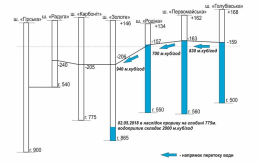
The Pervomaiskvuhillia (Pervomaiska Group) is a group of mines in the Luhansk Oblast. The individual mines have adjacent underground faults. In May 2018, the Zolote mine, which was located in Ukrainian-controlled territory at the time, flooded. Water seeped through cracks in the rock of the adjacent mines and eventually broke through. 2000 cubic meters of water per hour flowed into the Zolote mine from the upstream Rodina and Holubovska mines. The upstream mines are located in separatist territory. The flow of water into the Zolote mine was so high that the reprocessing plant in Zolote was unable to process the water volumes and the contaminated water was discharged unfiltered into the Komyshuvakha River.7
Exact data on the current state of the mine is not available, but the latest study from 2021 shows an increased volume of water entering the Zolote mine. If the water retention in the upstream Pervomaisk Mine and Holubusk Mine were to stop completely and permanently, the heavily contaminated water would come to the surface in the foreseeable future, flooding around 6,000 hectares of land and thus threatening the towns of Kirovsk, Pervomaisk, Zolote, Hirske and Karbonit (approx. 80,000 inhabitants) with severe waterlogging. 8
A study from 2021 examined the Komyshuvakha River, into which the water from the Zolote mine was and perhaps still is discharged. The river has elevated chlorine levels and in many cases elevated sulphate levels.9 Like most rivers in the region, the river, which is also heavily discolored, flows into the Siversky Donets River and the Siversky Donets Reservoir. The reservoir is the main source of drinking water for the entire region. 70 percent of the population of Donetsk and 30 percent of the population of Luhansk depend on this reservoir. This corresponds to an approximate population of around 300,000 people.
Water flow through various mines in the Donbas region
Example Yunkom Mine
A unique example in the Donbas region is the Yunyi Komunar Mine (Yunkom Mine). A nuclear explosion with the equivalent of 200-300 tons of TNT10 was carried out experimentally in this mine in 1979 (at that time still in the Soviet Union). The mine belongs to a group of mines that are connected to each other. The aim of the experiment was to secure the mine and prevent regular gas leaks in the mine. For the explosion, various safety measures were taken to secure the shaft and the chamber of the explosion. Due to the radioactive hazard, the mine was specially secured and was previously considered to be relatively stable due to its rock strata and the safety measures for the blast. The maintenance of this mine and especially the blast chamber is of the utmost importance for the region.
If you want to estimate the consequences that would result from a collapse or flooding of the mine, you can only make rough assumptions. The experiment is the only one of its kind in the world in such a densely populated mining region. However, if the mine were to be flooded, this would endanger the stability of the explosion chamber in particular, as it could collapse. This could result in over 500 cubic meters of highly radioactively contaminated water escaping from the chamber into the surrounding soil in the region.11
Geological situation in the Yunkom Mine
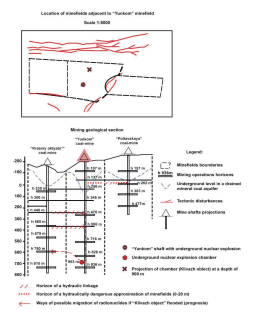
According to several reports, the separatist administration decided in 2018 to stop the costly maintenance of the mine. In 2020, the International Human Rights Community found that low-level radioactive water had already leaked into the groundwater. A statement by the Ukrainian delegation to the UN General Assembly in February 202212 states that radioactively contaminated water is already reaching the Sea of Azov and ultimately the Black Sea via the Kalminus River and the aforementioned Siverskyi Donets River. 13 There is an urgent need for international experts and the International Atomic Energy Agency to gain access to the mine and verify these reports.
Significance of this environmental damage
Groundwater in the region
What applies to the Zolote and Yunkom mines also applies to many other abandoned mines in the region. According to various reports, more than 35 old mines are now considered to be completely flooded.14
The above-mentioned problem of mine flooding poses an acute threat to the groundwater in the entire region. Soil samples confirm that contamination has already begun: In 2016, the Centre for Humanitarian Dialogue was able to take and analyze water samples on both sides of the conflict line in the Donbas. 35 samples were taken on the Ukrainian-controlled side, 26 samples in separatist-controlled territory:
Ukrainian-controlled territory:
- 100% of the surface water samples were contaminated.
- 75% of the samples from underground waters were contaminated.
Territory controlled by separatists:
- 85% of the surface water samples were contaminated.
- 85% of the samples from underground waters were contaminated.
Chlorine, sulphates, nitrates, iron, manganese, mercury, arsenic, copper and lead as well as various hydrocarbonates were found.15
80-90 percent of the water in the Donbass region is taken from the Siversky Donets River. The extracted water is unprotected surface water, which consists of a system of reservoirs, canals and pipes. Since the outbreak of the conflict, the water quality has been severely threatened and extraction has been repeatedly stopped due to excessive contamination. 16
Lowering the floor
The State Service for Geology and Subsoil of Ukraine assumes that the conflict in the separatist areas has resulted in illegal coal mines covering an area of more than 4,500 square kilometers. These mines are not secured by certain infrastructure and controls, as would be the case with a state-controlled mine, but are created at shallow depths, i.e. just below the surface, partly due to a lack of equipment. The problem, which already existed before the conflict, has been exacerbated by the separation of the separatist areas from Ukraine. Like the uncontrolled flooding of mines, these illegal mining activities just below the surface are leading to subsidence of the soil throughout the Donbas. Various studies estimate that around 12,000 hectares of land are at risk of subsidence. According to information from 2018, cities in the Kyivski region have sunk by 53 centimetres, in the Kalininsky region by 69 centimetres and in the Petrovskyi region by 92 centimetres.17 This uncontrolled subsidence is not only a threat to buildings and people, but also to the environment. Urban infrastructure such as gas pipelines, sewage and fresh water, as well as the industrial buildings located in this region, are being destroyed and contaminating the soil and groundwater.
Induced earthquakes
Induced earthquakes are man-made earthquakes that can be caused by various activities such as mining. How these earthquakes occur is a complicated process and cannot be explained further here. However, the risk of induced earthquakes increases significantly with the lack of maintenance and servicing of mines and is a major risk for people and the environment, especially in the densely populated Donbas region.
Conclusion
The damage to the Ukrainian environment described in this article is only part of the overall extent of this war. How much habitat for flora and fauna was permanently destroyed, how many (endangered) animal species were decimated in their numbers and how much soil is still contaminated with ammunition remnants and other pollutants decades after the war will only become clear after the war.
Further damage
Water supply
Since the beginning of the war, Russia has launched more than 3,000 missile attacks against Ukraine. In addition to gas, oil and ammonia pipelines, these attacks have also targeted infrastructural buildings in Ukraine’s water supply system. In the city of Mariupol (approx. 400,000 inhabitants), the fresh water supply has collapsed due to heavy fighting and bombing. Attacks on pumping stations and severe damage to the pipes lead to the mixing of fresh and waste water. Wells and other natural sources of drinking water are heavily contaminated and can no longer be used. Especially in summer, wells contaminated with wastewater are a breeding ground for infectious diseases such as cholera or dysentery.18
Destroyed chemical tanks
Russian cruise missiles damaged six reservoirs with organic fertilizers in the Ternopil oblast, releasing chemicals into the environment. The State Environmental Inspectorate of Ukraine reported a dangerous concentration of ammonia in the Ikva River, which was 163 times higher than the maximum safe level for this substance. An unusually high number of dead fish were found in the river and people were banned from using water from wells due to possible poisoning.19
Destroyed sewage treatment plants
A sewage treatment plant in the town of Vasylivka was shelled. Due to the destruction of the pumping plant, the wastewater flowed unfiltered into the Dnieper River. The Dnieper is the third longest river in Europe and flows into the Black Sea.20
Factories under fire
The release of nitric acid and ammonium nitrate into the environment as a result of shelling of factories in the Donbas has already been recorded several times.21 Both are highly toxic substances for humans and animals.
Fires
In July 2014, a fire broke out at the Lysychanskyi oil refinery after it had previously been attacked. 50,000 tons of oil sludge, 20 tons of petrol and a sulphur depot caught fire. On September 31, 2020, a fire broke out in the Luhansk region, destroying more than 20,000 hectares of forest.22
Dolphins
Numerous dolphins strand and die in the Sea of Azov & Black Sea. The animals communicate with different sounds. Due to the high decibel levels of the Russian fleet’s sonar systems, the animals get lost.23
This is how you can support our partner organizations:

List of sources:
- Yevhenii Yakovliev, Sergiy Chumachenko (2017, Ecological Threats in Donbas, Ukraine – Assesment of the ecological hazards in Donbas impacted by the armed conflict in eastern Ukraine
- Truth Hounds, NED (2021): Donbas Environment: Invisible Front – Environmental consequences of the war in the East of Ukraine in the context of international humanitarian law and in the practical dimension
- Nickolai Denisov, Dmytro Averin, OSCE (2017), Environmental assessment and recovery priorities for eastern Ukraine
- Truth Hounds, NED (2021): Donbas Environment: Invisible Front – Environmental consequences of the war in the East of Ukraine in the context of international humanitarian law and in the practical dimension
- Rebecca Barh (2022), Environmental disaster in a war zone, Deutschlandfunk Kultur
- Truth Hounds, NED (2021): Donbas Environment: Invisible Front – Environmental consequences of the war in the East of Ukraine in the context of international humanitarian law and in the practical dimension
- Truth Hounds, NED (2021): Donbas Environment: Invisible Front – Environmental consequences of the war in the East of Ukraine in the context of international humanitarian law and in the practical dimension
- Nickolai Denisov, Dmytro Averin, OSCE (2017), Environmental assessment and recovery priorities for eastern Ukraine
- Truth Hounds, NED (2021): Donbas Environment: Invisible Front – Environmental consequences of the war in the East of Ukraine in the context of international humanitarian law and in the practical dimension
- Yevhenii Yakovliev, Sergiy Chumachenko (2017, Ecological Threats in Donbas, Ukraine – Assesment of the ecological hazards in Donbas impacted by the armed conflict in eastern Ukraine
- Yevhenii Yakovliev, Sergiy Chumachenko (2017, Ecological Threats in Donbas, Ukraine – Assesment of the ecological hazards in Donbas impacted by the armed conflict in eastern Ukraine
- Statement by the delegation of Ukraine at the UN General Assembly debate on agenda item “Situation in the temporarily occupied territories of Ukraine” (23 February 2021)
- Guillaume Ptak, Deutsche Welle (2021), Environmental disaster in Ukraine’s war zone
- Truth Hounds, NED (2021): Donbas Environment: Invisible Front – Environmental consequences of the war in the East of Ukraine in the context of international
- Yevhenii Yakovliev, Sergiy Chumachenko (2017, Ecological Threats in Donbas, Ukraine – Assesment of the ecological hazards in Donbas impacted by the armed conflict in eastern Ukraine
- Yevhenii Yakovliev, Sergiy Chumachenko (2017, Ecological Threats in Donbas, Ukraine – Assesment of the ecological hazards in Donbas impacted by the armed conflict in eastern Ukraine
- Truth Hounds, NED (2021): Donbas Environment: Invisible Front – Environmental consequences of the war in the East of Ukraine in the context of international
- Tagesschau (2022), Hardly clean water-food as a reward
- Maryna Ratushna, Ecoaction (2022), War against nature: The environmental damage of Russia’s full-scale invasion of Ukraine
- Maryna Ratushna, Ecoaction (2022), War against nature: The environmental damage of Russia’s full-scale invasion of Ukraine
- Maryna Ratushna, Ecoaction (2022), War against nature: The environmental damage of Russia’s full-scale invasion of Ukraine
- Truth Hounds, NED (2021): Donbas Environment: Invisible Front – Environmental consequences of the war in the East of Ukraine in the context of international humanitarian law and in the practical dimension
- Truth Hounds, NED (2021): Donbas Environment: Invisible Front – Environmental consequences of the war in the East of Ukraine in the context of international humanitarian law and in the practical dimension
- Black Sea Womens Club