


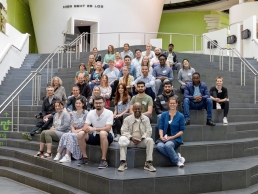
KlimaGesichter: Specialist workshop in Bremerhaven
August 02, 2021
Specialist workshop in Bremerhaven – Our climate face project enters its final round.
The grand finale: after 1.5 years of joint work, many workshops and successful commitment, 45 people from 23 nations were qualified as climate ambassadors. The project, which we have already reported on several times, trains people with a migration background and a history of flight to become climate ambassadors. Climate change is already affecting the lives of many people today and is one of the main causes of displacement. The project provides these people with the core skills they need to act as climate ambassadors and report on the effects of climate change in their countries and hold workshops on this topic. On the last workshop weekend of this project, our 45 Climate Faces met for the first time in person in Bremerhaven and worked together on pressing issues affecting their home countries: Earth’s climate caprioles, stories of climate change success, climate communication or even the labor market situation for refugees/migrants and a consultation. The crowning glory of the weekend was the awarding of the certificates. After 1.5 years of exchanging ideas and learning from each other, the climate ambassador training is now coming to an end. The official conclusion of the “ClimateFaces – Intercultural Environmental Education” project will be the final conference on 11.11.2021 in Bremerhaven.
More information about this project can be found here: https://www.ufu.de/projekt/klima-gesichter-2/
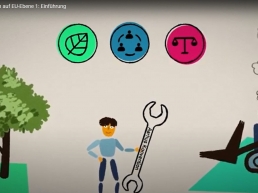
Influencing European environmental policy - new short films
July 12, 2021
What opportunities are there to campaign for environmental protection at EU level and to influence environmental policy and relevant legislative processes? Four new short films from UfU explain the importance of the Aarhus Convention and your rights to information, participation and legal action at EU level.
The Aarhus Convention: An international environmental treaty designed to strengthen civil society in the environmental field and create opportunities for participation. The Aarhus Convention is the first international environmental treaty that sets international minimum standards for access to environmental information for all people, regulates participation in environmentally relevant decisions and establishes access to justice in environmental matters. UfU has tried to explain how this works in short films. The first two films are now online and provide an introduction to the topic and explore the question of what is meant by environmental information and how to obtain it from EU institutions, e.g. the European Commission.
The Aarhus Convention at EU level 1: Introduction
https://www.youtube.com/watch?v=gusgm1o5szw
The Aarhus Convention at EU level 2: Access to information
https://www.youtube.com/watch?v=gSb6HsUOsF0
Two further short films explaining the opportunities for participation and rights of appeal at EU level will follow in the fall.
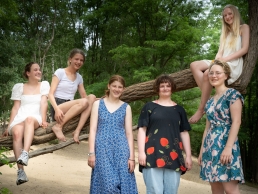
Three4Climate: Berlin weekend with winners of the climate neutrality competition
June 21, 2021
From June 18-20, 2021, a workshop on climate activism and public relations was held for the winners of the climate neutrality competition of the EUKI Three4Climate project. The 6 winners from Germany met in Berlin and took part in various activities such as a consumer-critical bike tour or a workshop with the Federal Agency for Civic Education. The focus was also on exchanging ideas with other climate protection activists. For example, the winners were able to exchange ideas with Fridays for Future activists from Berlin. In the evening, everyone was able to take part in the short film event “Floating Cinema” from a pedal boat on the Spree. On the last day, the students talked to a journalist about their experiences in climate protection, took press photos and made a film in the Sandgrube nature reserve in Jagen 86 of the Grunewald forest. At 34 degrees, a short dip in the Teufelssee was of course a must. At the same time, students from Portugal and Slovenia also met up. The winners in Slovenia spent the weekend in the Rakov Škocjan valley at Lake Cerknica, one of the largest lakes that disappears completely in the dry season. There they explored caves and went cycling. The students in Portugal went to Arrábida National Park near Lisbon and spent an action-packed weekend climbing in the great outdoors. Of course, networking between the three countries was not to be neglected. That’s why everyone got together on Saturday evening for the award ceremony in an online meeting. The winners were congratulated by Caterina Salb from the BMU and Linda Beyschlag from Guidehouse and motivated for further projects. The students also presented their projects to each other and discussed climate protection activities at their schools.

Our new rooms in the House of Democracy and Human Rights
- June 2021
UfU has moved. Although the address remains the same, we are now in new, even larger offices in the House of Democracy and Human Rights. For UfU, this move is also an investment in the future in times of corona and working from home. We are growing steadily and if we believe that working from home will continue to be an issue after the pandemic, we want to give our employees the opportunity to work in the office in the future. UfU is now located in the middle and rear building on the fourth floor, bringing two previously separate parts of the institute back together. We are still busy unpacking some of the boxes, but are already looking forward to welcoming visitors to the institute.
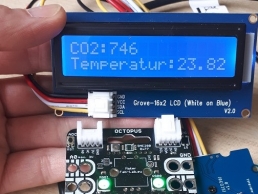
“Is it still possible to save energy when everyone is ventilating like crazy?”
June 02, 2021
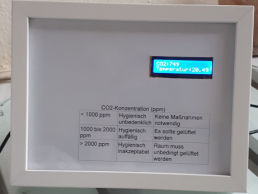
Energy saving goes digital – Hanover school exchange and CO2 traffic light workshop on “Ventilation in times of corona”
Despite coronavirus and the resulting lack of opportunities to hold events in person, the Energy Efficiency and Energy Transition department has remained in contact with “its” schools as the school year draws to a close. Cross-school events such as the annual exchange meeting in the GSE energy-saving project (organized by the City of Hanover’s Building Management Department) and a workshop on building your own CO2 traffic lights have taken place online in recent months.
The school exchange on April 27 for Hanover schools focused on how energy can be saved even in times of continuous ventilation due to the pandemic. Corona in particular has given rise to new requirements that also have an impact on energy consumption. In addition to two exchange rounds, one with a pedagogical focus and one with a technical focus, the participating teachers listened to a presentation on “Aerosols, air exchange, window ventilation and CO2 values as a measurable point of reference for orientation”, in which the question of how the virus can be dangerous in schools and how the risk of infection can be minimized was explored. As part of the support for the committed energy savers, the schools were also offered a new event in the energy-saving project in addition to the offer to borrow CO2 traffic lights from the school authorities: the self-construction of CO2 measuring devices with a small group of pupils. On June 1, a CO2 traffic light workshop took place as part of the GSE project in cooperation with the building management department of the state capital of Hanover under the direction of Ms. Schacknat (engineer and school supervisor at UfU). Especially during the corona pandemic, there is great interest in schools in proper ventilation, and the self-built CO2 traffic lights are intended to support this and at the same time awaken the pupils’ spirit of research with this exciting STEM project. All 12 schools received the materials and assembly instructions by post in advance, as the workshop took place online due to the coronavirus. After initially having to solve technical problems, the components were quickly assembled by all groups and the programming could begin. The applications and algorithms required for this could be clicked together in a graphical user interface without any programming knowledge. The students created the individual modules with the support of their teachers on site. The first task was to show the display, the CO2 value and the temperature. Once everyone had succeeded in doing this, the LED was to light up in the appropriate color according to the CO2 content of the room air: the LED was to light up green at a value below 1000 ppm (parts per million), yellow up to 1,500 ppm and red above 1,500 ppm. In this way, a critical CO2 value can be immediately recognized and ventilated during subsequent use in the classroom. In addition, the CO2 traffic lights could optionally be connected to the WLAN so that the values could be called up graphically on an external website. Great traffic lights were created for use in times of corona, for which stylish housings were then creatively developed and built. Due to the many positive responses and other interested schools and groups of pupils, further CO2 traffic light self-construction workshops are planned for the new school year.
Principles of data use for a socio-ecological Berlin
April 30, 2021
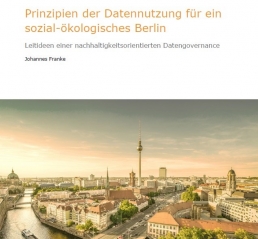
Ecornet paper: Principles of data use for a social-ecological Berlin
The innovative use of data has enormous potential to drive forward the socio-ecological transformation in Berlin. Among other things, public transportation, urban infrastructure and climate and health protection in general can benefit from data-driven innovations. However, this potential for the common good does not realize itself. Without political control, the use of data will continue to be driven primarily by profit interests. Sustainability-oriented data regulation is therefore required. Such regulation is a complex task that must take into account different goals and interests. The formulation of “data principles” can provide orientation and sharpen the focus on conflicting objectives. This background paper (EcornetBerlin_Report4_Principles of data use – German only) therefore examines four different discourses on “good” data use from a socio-ecological perspective and derives six principles for sustainability-oriented data regulation in Berlin: individual data sovereignty, data transparency, data solidarity, data sufficiency, data responsibility and public data sovereignty. Finally, these principles are related to the specific options for action and regulation in the city of Berlin. The background paper is part of the Ecornet project “Data governance and regulation for a sustainable Berlin”. As part of the Ecornet Berlin research network, UfU is investigating on behalf of the Berlin Senate what a data regulation for Berlin that is oriented towards the common good could look like. Contact: Dr. Johannes Franke
Recommendations for Air Quality Management in Vietnam
22.04.2021
Since 2019 UfU and Ecologic Institute, commissioned by the GIZ, have been accompanying the legislative process for the amendment of the Vietnamese Environmental Law (LEP), especially the chapters on environmental permits and air pollution control. As part of the project “Development of recommendations (based on best practices, among others) on how to implement and operationalize the revised Law of Environmental Protection of Vietnam” UfU and Ecologic commented on the draft for the LEP amendment and provided recommendations for further improvements, for air quality management, and support in the preparation of the subsequent LEP implementation.
While the LEP amendment entails significant progress at the national level, the provinces often struggle with the implementation of national requirements. In the field of air pollution control, the new LEP requires all provinces to develop air quality management plans from 2022 on. In order to support this process, the Vietnamese Ministry of Natural Resources and Environment prepared a Technical Guideline on Air Quality Management Planning for provinces. However, this guideline does not provide recommendations and guidance on the specific measures that the provinces could include into their management plans.
Therefore, UfU and Ecologic developed a package of three publications on concrete tools and recommendations for air quality management measures for the provincial authorities in Vietnam:
- Table of Air Quality Management Activities (AQMA-TABLE) for emission reduction and health protection
- Local Air Quality Management – Manual for combined use with the AQMA-Table
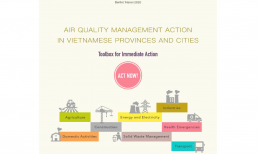
- Toolbox for Immediate Action
The first document, the AQMA-Table, lists potential measures that the provincial authorities can implement and include into their management plans in the areas of Agriculture, Construction, Industries, Energy and Electricity, Transport, Domestic Activities, Solid Waste Management, as well as Health Emergencies. The second document, the accompanying manual to the AQMA-Table, elaborates in a first step on the table and the different information it provides. In a second step, it outlines the process of how to choose appropriate measures for a province’s air quality management plan. Finally, the third document serves as a toolbox for immediate action within the provinces. Since the new LEP and thus also the provincial air quality management plans will not enter into force before 2022, but with air pollution already being an urgent issue at the moment, immediate action against air pollution is of utmost importance. Therefore, the document provides recommendations on measures that can be implemented right away, i.e. that can be taken within the current national legal framework, without the establishment of new regulations, and without further research and evaluation. In this way, the three documents can support the provincial authorities in the development of the program of measures of their air quality management plans and encourage them to become active against air pollution already before and during the development phase of the plans.
Virtual study visits in the BEACON project
09. April 2021
The idea of study visits
The BEACON (Bridging European and Local Climate Action) project has been running at UfU since spring 2018 and is a project to promote climate protection through the exchange between national governments, municipalities and schools in Europe. The aim is to contribute to a stronger European integration through a bilateral and multilateral dialogue in order to ultimately create the common goal for the implementation of the Paris Climate Agreement.
As a highlight of the BEACON project, two study visits were planned, during which representatives of the partner countries Bulgaria, the Czech Republic and Romania were to be invited to Germany. A three-day program was planned with 15 educational policy multipliers each, such as speakers in teacher training, representatives from school authorities and school ministries. The study visit program should include schools and educational institutions that carry out energy-saving projects as well as energy-saving laboratories and other environmental educational institutions. The aim of the study visits was to network the actors with one another and to use the impulses of the program to discover common points of contact for work in the field of climate protection.
The first study visit with all three countries could take place as planned in autumn 2019. Invitations were made to Berlin and here the guests were able to visit various schools and hold expert talks in order to get to know energy-saving projects on site. Excursions to energy laboratories and discussions with climate protection managers and the Senate administration were also on the program and were able to provide important impulses.
The switch to digital contributions
The second study visit was to be carried out in the first half of 2020 and has been postponed repeatedly due to the pandemic. In the course of the planning it became clear that international trips could not take place during the project period and that an alternative format had to be developed. The crux of the matter is that these study visits thrive on the network character and direct exchange and cannot easily be converted into a digital format. The guiding principle of the UfU was now to provide the multipliers in the partner countries with some informative and descriptive contributions as best practice examples for local climate protection. The result were two 15-minute videos in which we worked with a professional film team:
In the film “Wind, Wagnis, (Mit)Wirkung”, the energy self-sufficient place Feldheim is presented, which we would have liked to have visited with the guests on a study visit. It is the first and so far only place in Germany that completely generates its own electricity and heat for its own use and is thus playing a pioneering role in the energy transition. Barbara Ral, Climate Protection Manager of Potsdam-Mittelmark, and Michael Knape, Mayor of Treuenbrietzen, report in the film how the interplay of favorable starting conditions, the courage of individuals to dare something new and the broad participation of citizens contributed to the success of such a pilot project what steps were necessary and what obstacles there were.
Karola Braun-Wanke and Judith Hübner from the environmental coordination office of the Berlin district of Steglitz-Zehlendorf were interviewed for the film “Vernetzt-Aktiv-Nachhaltig”. In the Botanical Garden in Berlin they report on how the coordination office came into being, what goals it is pursuing, what their work looks like in practice and what role networking plays in it. They also provide information about their educational mandate and the environmental model, which is being pursued by the city of Berlin. The establishment of the Berlin environmental coordination offices was preceded by an appraisal process on environmental education offers in the districts, in which the UfU was involved. As part of the film screenings, the UfU management explained the development process of the coordination offices.
Another UfU contribution was made for the Bulgarian partners at their request for the National Climate Protection Initiative of the Federal Environment Ministry (NKI). In collaboration with Lothar Eisenmann from ifeu (Institute for Energy and Environmental Research Heidelberg), the NKI was presented live as an example of funding opportunities for sustainable educational projects and other climate protection activities in German municipalities and schools.
The study visits were now mainly organized by the local partners and the UfU contributions were integrated into the program. The events in the Czech Republic and Bulgaria already took place as purely online workshops and the UfU contributions were received with many interested inquiries and a lively exchange of discussions. The Romanian study visit is planned for mid-April as a hybrid event: The educational policy multipliers meet on site in Romania, get to know various educational institutions in the area and the UfU is digitally connected for the contributions. Such a format is certainly a welcome change from the purely digital alternative and we keep our fingers crossed that the pandemic will not thwart the bill again!
UfU lecture: Principles of sustainable data regulation
April 07, 2021
What can sustainable data regulation look like and what guiding principles should it be based on? Dr. Johannes Franke spoke about this question to representatives of civil society at the Digital Social Summit on March 30, 2021. The full presentation can be viewed here (German only). Digitalization holds enormous opportunities, but also risks for the socio-ecological transformation of society. For example, artificial intelligence (AI) can make climate and environmental protection more effective and efficient, but it can also be used to increase unsustainable consumption and profits. Which scenario becomes reality depends, among other things, on data regulation: Who should have access to which data and for what purposes? Important decisions are currently being made at a political level. Civil society must exert influence to ensure that future regulation is based on principles that promote sustainable data use: individual and public data sovereignty, data transparency, data solidarity, data responsibility and data sufficiency. The presentation was developed in the context of the project “Data governance and regulation for a sustainable Berlin”. As part of the Ecornet Berlin research network, UfU is investigating on behalf of the Berlin Senate what data regulation for the common good could look like in Berlin.
Contact: Dr. Johannes Franke
Fourth Aarhus Workshop
24 March 2021
On 24 March 2021, the Independent Institute for Environmental Issues e.V. – UfU – and the University of Coimbra organised the fourth digital Aarhus Workshop to discuss public participation and access to justice at European Union level. While UfU hosted and moderated the fourth Aarhus Workshop, Ms. Dr. Alexandra Aragão, who is a reknown Portuguese Professor at the Faculty of Law of the University of Coimbra, teaching environmental law, European law, risk governance and food security law, enriched the event with her well-founded and substantial presentations and contributions.
More than 20 Aarhus-interested participants from environmental associations, foundations, universities, governmental organisations as well as legal professionals took part in the fourth digital Aarhus Workshop. Most participants came from Germany, Portugal and Slovenia, those three countries, who are together holding the EU Trio Council Presidency in 2020 and 2021. On 1 January 2021, Portugal took over the EU Council Presidency from Germany and it will soon be handed over to Slovenia.
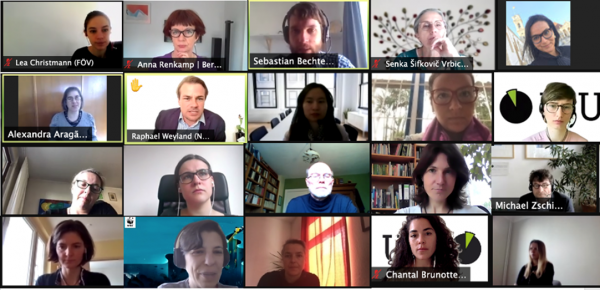
At the beginning of the Workshop, Dr. Catarina Grilo, Director of Conservation & Policy at ANP in association with WWF Portugal, delivered some insights on the Portuguese Presidency of the Council. After Catarina’s sharp observations on Portugal’s achievements in strengthening European environmental law and environmental democracy, Sebastian Bechtel, LLM, environmental democracy lawyer at ClientEarth Brussels, provided a captivating presentation on the new developments around the Amendment of the European Aarhus Regulation. The short presentation on access to justice included the advice of the Aarhus Convention Compliance Committee in ACCC/M/2017/3 of 12 February 2021 and the findings of the Committee in ACCC/C/2015/128 (European Union) of 17 March 2021. He talked about the current legislative procedure and how environmental NGOs and other stakeholder participate in it.
After a short break the main focus of the Workshop laid on two questions: “How can citizens & NGOs participate in European environmental decision-making?” and “How can electronic public participation in European environmental decision-making be strengthened?” First, Prof Dr. Alexandra Aragão gave an overview of the multifaceted public participation opportunities in Europe, e.g. the Eurobarometer, public consultations, legislative initiatives or citizen science. After the systematic presentation of central reactive and pro active participation options for European citizens and environmental NGOs by Ms. Aragão, a Panel discussion on online public consultations, who are conducted by the European Commission, followed. Part of the multi-stakeholder panel discussion were a legal scholar, two environmental NGO experts and one participation expert respectively:
- Prof. Dr. Maria Alexandra de Sousa Aragão,
- Rebecca Humphries, Senior Public Affairs Officer at WWF European Policy Office (EPO)
- Dr. Raphael Weyland, Head of Brussels Office at Nature & Bio-diversity Conservation Union (NABU) in association with BirdLife Europe, as well as
- Anna Renkamp, Senior Project Manager Bertelsmann Stiftung.
The main arguments of all panellists during the fruitful discussions are captured in the Presentation to our fourth Aarhus Workshop
After the panel discussion some time was left to discuss the pressing question where and how citizens and NGO representatives could complain if they could not participate effectively online.
Due to the limited time available to discuss the online public consultations conducted by the European Commission, UfU and the University of Coimbra agreed to prepare a discussion paper on strengthened E-participation in European environmental decision-making.
The next and final fifth Aarhus Workshop on 7. September 2021 will fall under the EU Council Presidency by Slovenia. It will be held shortly before the seventh session of the Meeting of the Parties of the Aarhus Convention (MoP 7) from 18. to 21. October 2021. If you want to join the fifth Aarhus Workshop, please register here: https://www.ufu.de/en/5-aarhus-workshop/.
All five Aarhus Workshops are part of the project “European Implementation of the Aarhus Convention in the Digital Age (EU-AarKo)” of the Independent Institute for Environmental Issues UfU e.V. This project is financially supported by the German Environment Agency (UBA) and the Federal Ministry for the Environment, Nature Conservation and Nuclear Safety within the framework of the sponsorship of environmental associations.
For more information about this project and its background, click here.
For any questions, please contact Kathleen Pauleweit: kathleen.pauleweit@ufu.de