



Public participation must also be possible during the pandemic - Opinion

February 19, 2021
More than 2,000 infrastructure projects are affected by the Planning Guarantee Act every year. In plain language, this means that civil society must generally have the opportunity to have a say in over 2,000 projects. These objections must be heard and taken into account in dialog form at so-called discussion meetings. Due to the coronavirus pandemic, it is currently not possible to organize such physical events for citizens. Conversely, however, this does not mean that citizens can no longer exercise this right. On the contrary – solutions must be found. In defense of the authorities, it must of course be said that a switch to digital meetings was not to be expected, especially at the beginning of the pandemic. Many authorities were simply overwhelmed by the new situation. But now, in February 2021, different demands can be made. Now that businesses, schools and private individuals across the country have had to switch to digital conferencing and citizens are working from home, it is reasonable to expect the authorities to have set up conferencing systems such as Zoom, MS Teams, Big Blue Button or similar. The reality is different: The authorities’ digital portals are hidden, the files have cryptic names and objections can only be made in writing. Especially as only a fraction of the approx. 2000 projects have been made available at all. Real public participation looks different. After all, a written objection via a ready-made form is not the same as a physical discussion meeting. Together with the Deutscher Naturschutzring, Deutsche Umwelthilfe and Green Legal Impact, UfU demands in its statement that the Planning Protection Act, which is to be extended, should not only be extended but also further developed. Click here for the statement: Extension_Planungssicherstellungsgesetz_Stellungnahme_UfU_DNR_DUH_GLI (German only)
BEACON will soon be three
18. Februar 2021
The BEACON project, in which the UfU is part of the core consortium, has now been running for almost three years. During this time, a lot has happened in the work package concerning schools. The main focus here is on creating framework conditions that allow all schools in the partner countries to carry out long-term energy-saving projects. In this context, workshops in various formats were held, Romanian, Czech and Bulgarian delegations took part in study visits to Germany, German schools exchanged ideas and experiences with schools from the partner countries, and teacher training courses on the subject of energy saving and bicycle cinema film screenings took place.
Videos of Bulgarian activities give an exemplary insight into the BEACON project:

Citizen Science - Citizen research with dogs

January 15, 2021
Citizen Science – Citizen research with dogs
The Federal Ministry of Education and Research is funding 15 new citizen science projects, including one UfU project. Citizen science projects aim to encourage citizens to conduct research. Together with the Helmholtz Center for Environmental Research and Wildlife Detection Dogs e. V., UfU will carry out a project to search for and identify invasive plant and animal species. The special feature: Dog owners are to learn how to find and identify these species with their dogs. Invasive and alien species can cause massive damage to fragile flora and fauna. As these species are alien, they often spread rapidly and displace native species. This can lead not only to problems for the protection and conservation of native flora and fauna, but also to problems for the economy and the health of the population in the new areas of occurrence. The occurrence of these species should be better monitored in future. The numerous dog owners in Germany should help with this. There are now around 9.6 million dogs (2018) in Germany. These animals are not only great companions but also excellent sniffers. Research has shown that dogs are not only better at finding these invasive species than humans, but that the error rate when identifying them is lower in dogs. This is because humans confuse the species too often. The Wildlife Detection Dogs association will be responsible for training the dogs and dog owners. The Helmholtz Center for Environmental Research will be responsible for mapping and geostatistical analysis, among other things. UfU is managing the project and will be responsible for implementing participatory formats for the citizen scientists.
Lack of public participation in infrastructure projects!
December 30, 2020
Lack of public participation in infrastructure projects!
Ten years after Stuttgart 21 – UfU is conducting an extensive study into the possibilities of public participation in infrastructure projects. According to EU law, environmentally relevant infrastructure projects must be listed in so-called EIA portals. The result: in 2018, there were around 2,000 planned projects for which the opportunity for public participation would have been mandatory. In fact, only 190 projects were listed in the relevant federal and state EIA portals. This result is devastating in that not only is current EU law being broken, but the acceptance of these projects among citizens is also suffering. The protests against Stuttgart 21 and against the expansion of the A49 in Hesse show that the public wants to have a say in such projects. On December 29, the Süddeutsche Zeitung reported on our investigation in the article “Little learned from Stuttgart 21”. UfU has summarized the results of the study in a background paper (German only). The full report can be found on the project page. UfU is organizing a digital symposium on this topic in March 2021. Click here for the press release (German only). You can find the full monitoring report here (German only).
UfU examines the Environmental Information Act UIG

December 15, 2020
Analysis of the application of the regulations of the UIG and development of optimization potential for unhindered and easy access to environmental information
Together with other cooperation partners from Leuphana University in Lüneburg and the Free University of Berlin, UfU examined the German Federal Environmental Information Act (UIG) in a study. The aim of the Act is to ensure free access to environmental information from bodies that are obliged to provide information and to actively disseminate environmental information. The study examines whether and how the aforementioned legal objectives of the UIG are achieved in practice. The evaluation follows the methodology of retrospective impact assessment. The study concludes that the UIG has essentially proved its worth and makes a number of suggestions for optimization.
Click here for the project description. Download the study here (German only).
Aarhus Workshop on access to justice at EU level
27th November Berlin
Third Aarhus Workshop on „How could access to justice at European Union level be improved?”
Almost three dozen Aarhus-interested participants from environmental associations, the legal profession and specialised lawyers took part in the third Aarhus Workshop on 17 November 2020. Sebastian Bechtel, environmental democracy lawyer for ClientEarth Brussels, introduced the Workshop with two intriguing presentations on the challenging questions: “What is wrong with access to justice in the European Union?” and “Does the Amendment to the Aarhus Regulation help?”. Two panel discussions with Aarhus experts from Germany, Portugal and Slovenia the EU countries which are currently sharing the Trio Council Presidency till the end of 2021 further elaborated on access to justice hurdles and identified concrete areas for improvement. Dr Raphael Weyland, Head of Brussels Office at Nature and Biodiversity Conservation Union (NABU); Catarina Grilo, PhD, Director of Conservation and Policy at ANP in association with WWF; and Senka Šifkovi Vrbica, legal expert at PIC Slovenia, shared their hands-on experience around accessing European and Member State courts. Dr Maria Alexandra de Sousa Aragão, Professor at University of Coimbra; Dr Vasilka Sancin, Associate Professor at University of Ljubljana and Director of Centre for International and Business Law; as well as Sebastian Bechtel, discussed with the participants how access to justice at European Union level could be further strengthened.
A joint position paper was developed during the third Aarhus Workshop. The “German Portuguese Slovenian Civil Society Declaration on Access to Justice for Citizens & NGOs at European Union Level” can be found here.
For any questions, please contact us: kathleen.pauleweit@ufu.de
The workshop is part of the project “European Implementation of the Aarhus Convention in the Digital Age (EU-AarKo)” of the Independent Institute for Environmental Issues (UfU e.V.). This project is funded by the German Environment Agency (UBA) and the Federal Ministry for the Environment, Nature Conservation and Nuclear Safety within the framework of the sponsorship of environmental associations.
For more information about this project and its background, click here.
Aarhus workshop on access to justice at EU level

November 27 Berlin
Third Aarhus workshop on “How can access to justice be improved at EU level?”
Around 30 people interested in Aarhus from environmental associations, the legal community and specialized lawyers took part in the third Aarhus workshop on 17 November 2020. Sebastian Bechtel, environmental democracy lawyer at ClientEarth Brussels, kicked off the workshop with two informative presentations on the following challenging questions: “What has gone wrong with access to justice at EU level so far?” and “Will the proposed amendment to the Aarhus Regulation remedy the situation?” In two panel discussions with Aarhus experts from Germany, Portugal and Slovenia, the EU countries currently holding the Trio Presidency of the Council of the European Union until the end of 2021, the obstacles to access to justice were identified and concrete areas for improvement were outlined. Dr. Raphael Weyland, Head of the Brussels office of Naturschutzbund Deutschland (NABU), Dr. Catarina Grilo, Director of Nature Conservation and Policy at ANP in cooperation with WWF Portugal, and Senka Šifkovi Vrbica, employee at PIC Slovenia, shared their practical experiences on access to European and national courts. Dr. Maria Alexandra de Sousa Aragão, Professor at the University of Coimbra, Dr. Vasilka Sancin, Professor at the University of Ljubljana and Director of the Centre for International and Economic Law, and Sebastian Bechtel discussed with the participants how access to justice can be further strengthened at EU level. A joint position paper was drawn up during the third Aarhus workshop. The “German Portuguese Slovenian Civil Society Declaration on Access to Justice for Citizens & NGOs at European Union Level” can be found here (will be submitted later). If you have any questions, please contact: kathleen.pauleweit@ufu.de The workshop discussion is part of the project “European Implementation of the Aarhus Convention in the Digital Age (EU-AarKo)” of the Independent Institute for Environmental Issues (UfU e.V.). This project is funded by the Federal Environment Agency and the Federal Ministry for the Environment, Nature Conservation and Nuclear Safety as part of the funding for associations. Further information on this project and its background can be found here.

Maintaining environmental standards - recommendations for action from environmental associations

November 25, 2020
Maintaining environmental standards and yet planning faster: recommendations from environmental associations for effective acceleration of planning
Together with other environmental associations and the umbrella organization of environmental associations DNR, UfU publishes recommendations for action to accelerate planning. Accelerating the planning process for major infrastructure projects is an important issue that has occupied politicians and associations for over 30 years. The environmental associations repeatedly emphasize that accelerating infrastructure planning is desirable in principle. But not at the expense of environmental standards. For this reason, the environmental associations have drawn up concrete recommendations for action and proposals to speed up the planning of infrastructure projects and at the same time maintain environmental standards. The paper is available as a PDF download here (German only).
Success stories from the small-scale climate protection projects in Central Vietnam
October 15, 2020
In our project on local pilot measures to raise awareness of climate change in Central Vietnam, which is funded by the German Federal Foreign Office’s Climate Fund, UfU is encouraging four young Vietnamese project teams to develop and implement their own project ideas. Despite the current challenges posed by the pandemic, the projects are progressing successfully. The project teams have written news to inform about the status and recent successes of their projects. Below you can read the news from the mangrove and biochar project teams.
Volunteer summer campaign 2020 and tree planting ceremony in Tan Ninh commune (written by Hoang Anh Vu)
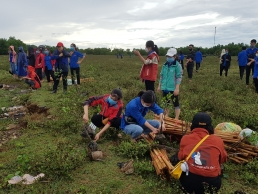
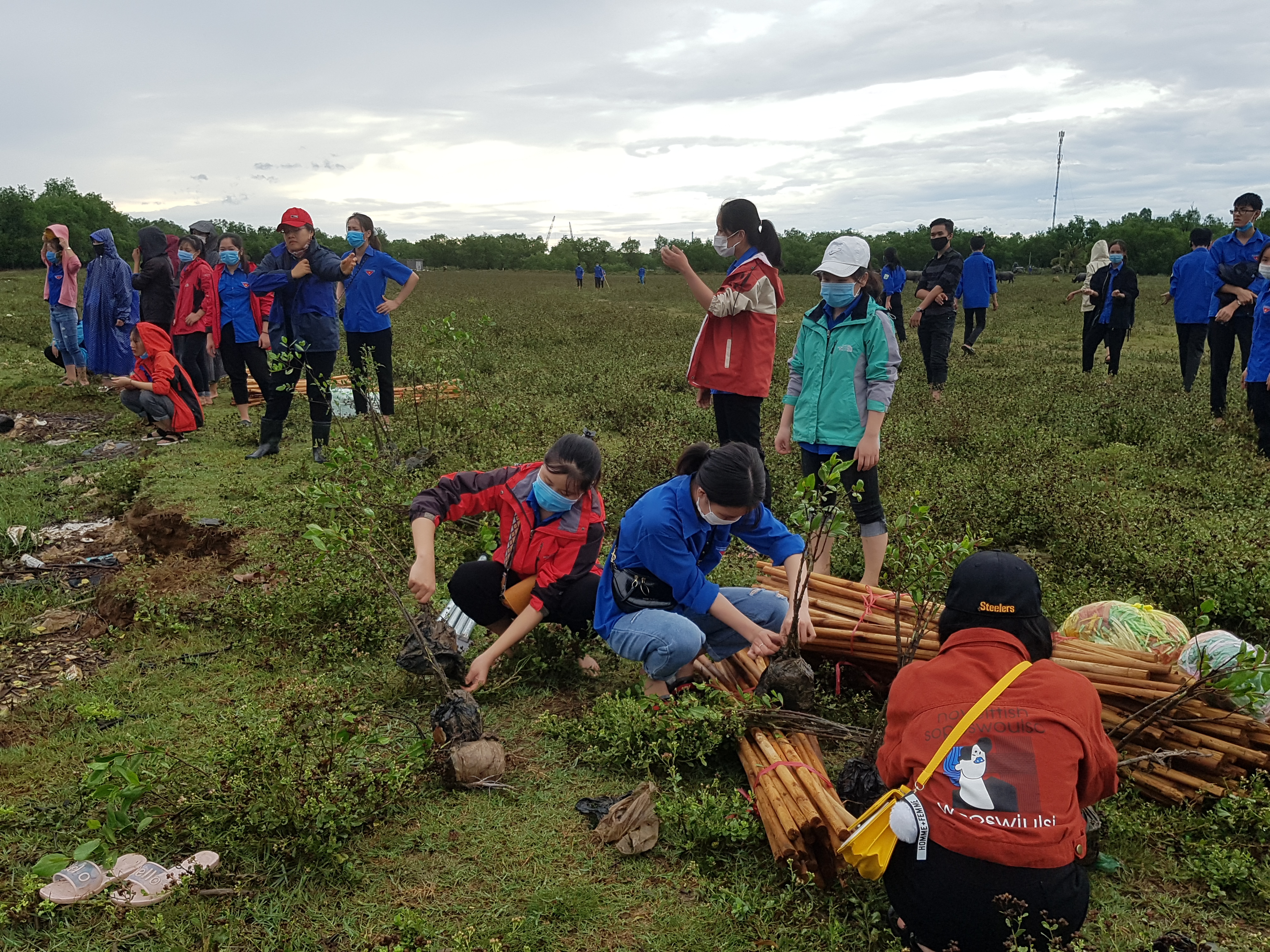
On August 2, 2020, the Communist Youth Union HoChiMinh of Quang Binh University and the Youth Union of Quang Ninh District organized a tree planting ceremony for the local population. The event is part of a small-scale project on climate change sponsored by the German Federal Foreign Office, the Independent Institute for Environmental Issues (UfU, Berlin) and the Mientrung Institute for Scientific Research (MISR, Hue City). Speaking at the tree planting ceremony, Mr. Hoang Anh Vu (project manager) explained that restoring the area along the Kien Giang River in Tan Ninh commune with mangrove trees will create new scenic value and thus serve local ecotourism. As the local people will recognize the value of the mangrove forest, they will plant more trees to further increase the forest’s expansion and permanence. The event was attended by about 250 volunteers, including local residents, members of the HoChiMinh Communist Youth Union of Quang Binh University and members of the Quang Ninh District Youth Union. During the event, the volunteers planted a total of 1000 mangroves along the Kien Giang River in Tan Ninh commune, Quang Ninh district. The organizers would like to thank all the volunteers who participated in the planting. Our special thanks go to the German Federal Foreign Office, the Independent Institute for Environmental Issues (UfU, Berlin) and the Mientrung Institute for Scientific Research (MISR, Hue City) for supporting this event. We hope to plant more trees in the future to further strengthen the community’s resilience to climate change.
Stove construction and biochar production in Krong Klang village in Quang Tri province (written by Nguyen Van Ky Truong)
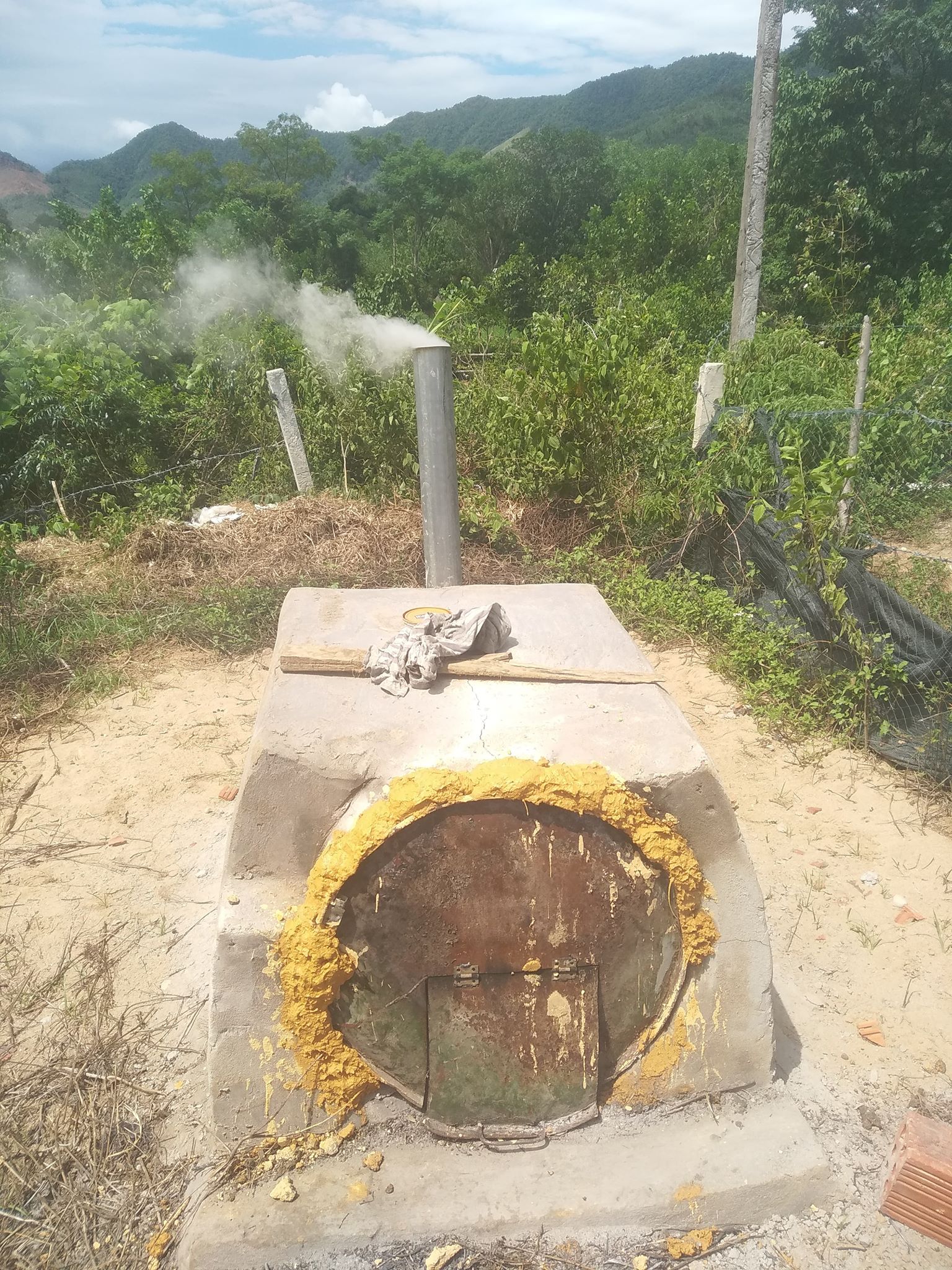
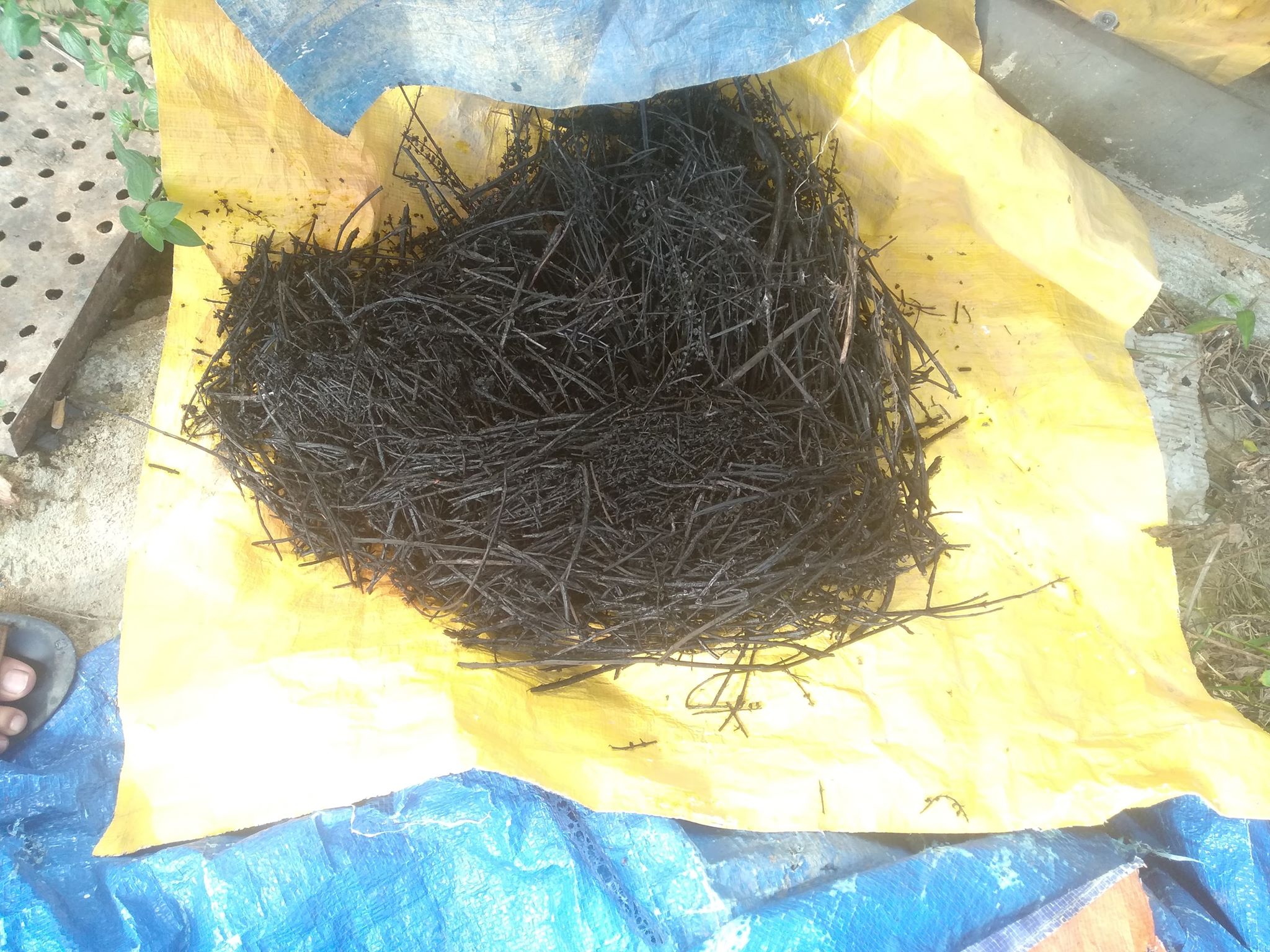
On July 22, 2020, the project “Pilot project for the conversion of agricultural waste products into biochar to reduce greenhouse gases and increase crop yields” was officially launched with the construction of the kiln for the production of biochar. The kiln consists of a 200-liter oil container with a small lid at the front and a metal chimney at the back. A metal grid inside the container allows for ventilation. The stove was placed on a concrete base and covered with bricks and mortar to protect it from severe weather conditions and heat loss. Five types of local agricultural waste products were used to make biochar, including kajeput, lemongrass, basil, ginger and turmeric, all in the form of softwood. It is estimated that 25 tons of this waste is dumped into the environment every month in the project area, polluting local air and water resources. From July 22 to August 6, we produced the biochar, but the amount produced did not meet expectations due to bad weather and difficulties with the combustion process in the kiln. Fortunately, such an initial challenge was soon over after the team gained experience in working with a new technology. The team then decided to use the social distancing phase to start cultivation trials with the produced biochar as fertilizer. We started with 4 different samples of peanut plants (a soil-only sample, a 2% biochar-soil mix, a 2% biochar-7% compost-soil mix, and a 7% compost-soil mix). The project team plans to continue with a total of 24 plant samples testing all 4 ratios of the biochar mix on a larger scale for three plant species (basil, ginger and peanut). Growth testing will be conducted twice a month based on plant growth criteria such as stem strength, plant height and number of leaves.



Release Event “Civic space for participation in climate policies in Colombia, Georgia and Ukraine”
23rd November 2020
SAVE THE DATE
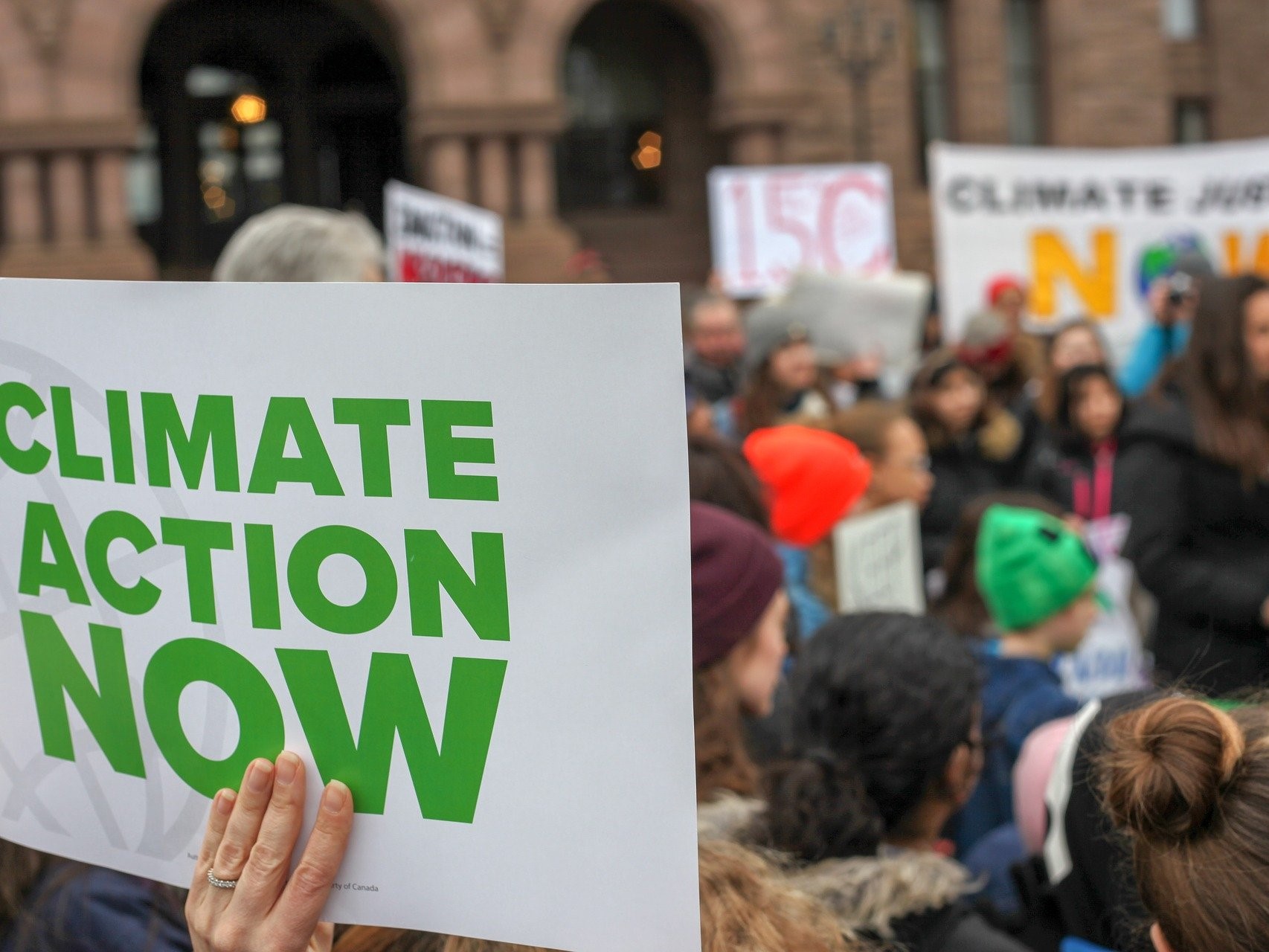
Join us online on November 4th, 2020 for the Release Event of our study “Civic space for participation in climate policies in Colombia, Georgia and Ukraine”
Civil society actors are key in raising the ambition of climate policies. Without civil society, there will be no socially just transition to a fossil-free world. National climate plans, including the Nationally Determined Contributions (NDCs) and long term climate strategies, benefit from diverse stakeholder engagement.
During the last months, UfU worked on a comprehensive study about opportunities of civil society (organizations) to participate in climate policies in Colombia, Georgia and Ukraine. In cooperation with BUND / Friends of the Earth Germany and Censat Agua Viva (COL), Ecoaction (UKR) and Greens Movement Georgia (GEO) the environment and conditions for climate-related participation were analyzed, such as the legal framework for participation, as well as concrete practices of participatory policy making, for example related to the recent revision of the Nationally Determined Contributions (NDCs).
We invite you to discuss with us the criteria for good practices of involving civil society in climate policy. The aim of the event is to inform about the results of the study and to bring together government and civil society actors for achieving better climate plans.
The event takes place on Wednesday, November 4 from 3 pm – 5.30 pm CET.
The detailed program will be announced in October. We will be using Zoom for the video conference, registration is required and will be possible from the end of October.
For any questions, please contact us: eva.laderick@bund.net
We look forward to seeing you online in November!
The event organization team

The event is part of the project Strengthen Civil Society for the implementation of national climate policy (ZIVIKLI) of BUND / Friends of the Earth Germany and the Independent Institute for Environmental Issues (UfU e.V.). This project is part of the International Climate Initiative. The German Federal Ministry for the Environment, Nature Conservation and Nuclear Safety promotes the initiative on the basis of a resolution of the German Federal Parliament.
For more information about this project and its background click here.